

全部动态
发布内容
2026
TP223 Touch Modules Offer Low-Power Switching Through Nonmetal Panels
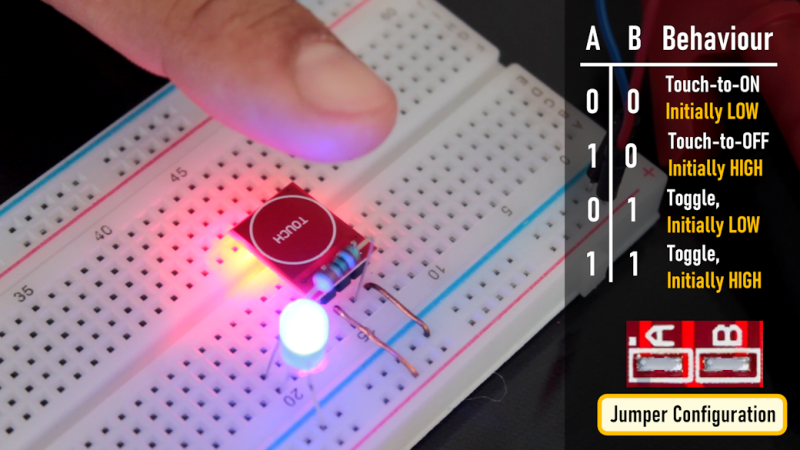
A Hackaday report describes using inexpensive TP223 capacitive-touch modules as alternatives to mechanical switches in project enclosures. The sensors can detect touch through plastic, glass, or wood, although increasing the panel thickness reduces sensitivity; a smaller touch pad or an external capacitor can also shorten the sensing range. The report says the modules draw less than 2 microamps at rest. Two initially unsoldered jumpers provide four output configurations: the default output goes high while touched, jumper A inverts that behavior, jumper B toggles the output with each press, and using both combines toggling with the opposite default state. A small capacitor on the power supply is suggested to address false triggers. The article notes possible use in 3D-printed designs and as a power switch, but gives no independent measurements or detailed implementation results.
The article provides practical configuration and power details for a touch-sensor module, but offers no independent testing or demonstrated project beyond the described use.
A DIY Guide to Mirror-Finish Nickel Plating for Tools
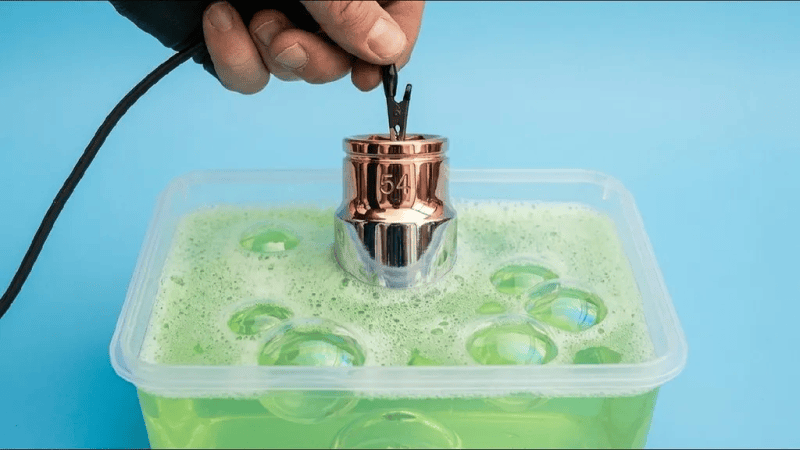
The article describes [Kovancapol]’s process for applying a mirror-finish nickel coating to tools. It notes that the setup involves nickel sulfate and nickel chloride, glassware, nickel anodes, and a power supply, and points to a video in which the plated results appear visually polished. The piece presents electroplating as a process that may become more approachable once the equipment and materials are assembled, but it does not provide quantified coating performance, durability testing, or detailed operating parameters in the supplied text. It also raises possible applications, such as coating conductive 3D prints, as speculation rather than demonstrated results. Using nickel on PCB traces may be impractical because oxidized nickel is difficult to solder. The article mentions combining plating finishes but offers no specific tested examples.
This is a practical hardware-related plating demonstration with visible results, but the supplied text gives no measured performance or detailed procedure, and some applications are speculative.

Free 3D-Printable Gothic Skull Lamp Uses Bambu’s MH001 LED Kit
Maker BattCave has shared files for a gothic skull-shaped USB LED lamp designed around the Bambu LED Lamp Kit MH001. The model uses a threaded base intended to simplify assembly, and colored gel films can be added to change the skull’s appearance. The listed print settings are 0.2 mm layers, three walls and 10% infill, with an estimated 17.6-hour print on one plate; PLA is recommended, and the showcased example uses Sunlu Matte White. The files are available on MakerWorld. The article presents the design and its suggested setup, but provides no independent measurements of brightness, print quality or assembly performance.
This is a usable, downloadable 3D-print design with specific print settings, but it is a single hobby lamp model and its illumination claims are not independently tested.
2026

Free 3D-Printable Skull Candle Nightlight Uses LED Strings or Tea Lights
Maker Mad_Power has shared a 3D-printable skull-shaped nightlight designed to resemble a melting candle. The project is intended as a Halloween decoration for a home or desk and is described as compatible with standard LED string lights as well as typical tea-light fixtures. The model can be printed using FDM in different colors, allowing users to vary its appearance. The article links to downloadable files on MakerWorld. It does not provide print settings, dimensions, electrical details, testing, or evidence about fit across specific light products, so those practical details cannot be confirmed from the supplied material.
The concrete item is a downloadable, FDM-printable decorative light with two stated lighting options; its novelty and practical scope are limited, and no technical specifications or compatibility testing are provided.

DIY Chromalux Lamp Combines a 3D-Printed Shade with Addressable LEDs
The featured Chromalux project, shared by luxellights on MakerWorld, is a DIY RGB lamp combining a 3D-printed base with interchangeable shade designs. Its listed electronics are an ESP8266 controller and six WS2812B LED-strip sections, each with 12 LEDs, for about 72 LEDs in total. The design calls for roughly 1.5 meters of strip with a width of 10 mm or less, and the post says a 5V, 2A USB charger is sufficient. It uses WLED firmware, installed through install.wled.me, and is configured as six segments. The project files are offered under a CC BY-NC license. The material describes a maker build and its components, not independent testing or a newly released commercial product; it provides no measured brightness, operating results, or detailed build instructions in the supplied text.
A concrete, replicable maker lamp specifies its controller, LEDs, power, and WLED setup; the material gives no independent performance tests and is not a commercial launch.
Maker Builds a Retro Bluetooth Handset to Reduce Smartphone Distractions
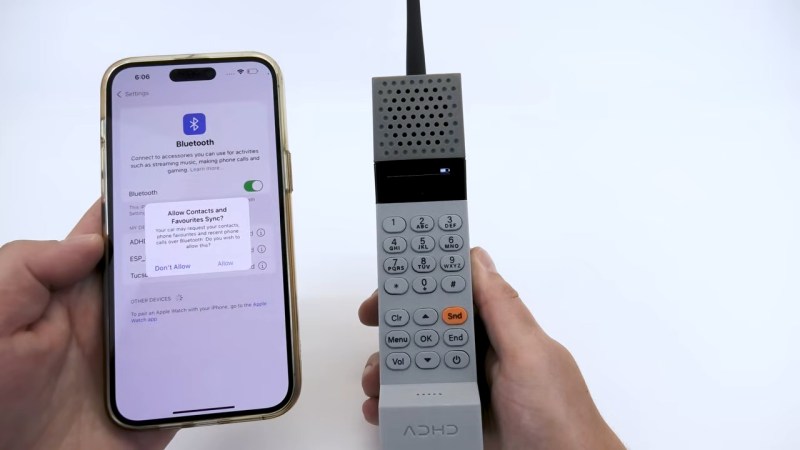
Kevin Noki has built a retro-styled Bluetooth handset as an alternative way to handle calls without picking up a smartphone. The device is not a standalone cellular phone: it pairs with a separate, professionally approved phone, since the build has no cellular modem and custom hardware access to VoLTE is difficult in many places. Noki initially used an ESP32, but switched to a dedicated Bluetooth Hands Free Profile module after finding the audio quality too poor. The project video shows a case-design process that uses XPS foam and a hand-operated hot-wire cutter for quick form iterations, followed by a single 3D-printed final case; a simple jig is used to bend the dark acrylic covering the display. The design is offered on Noki’s website, while the article says the on-screen details may be enough for others to reproduce it without purchasing the design. The handset can reduce the need to interact directly with a phone, but does not replace one.
The project demonstrates a concrete Bluetooth handset build and practical fabrication choices, but it depends on a separate phone and does not provide cellular service or independently verified performance.

Three 3D-Printable Tombstone Tea-Light Holders Use a Fuzzy-Skin Finish
Maxx_Design has shared a set of three tombstone-shaped tea-light holders intended for 3D printing, with an alternative design that omits crosses. The holders are described as fitting round tea lights up to 40 mm in diameter and use a two-piece construction. The print guidance specifies orienting the tombstones at a 45-degree angle; the base plates use 150% flow and a Hilbert-curve pattern to create the fuzzy top texture. The lower portions of the stones should be printed without fuzzy skin so the parts fit together properly. The files include preconfigured profiles with custom fuzzy-skin settings and manual supports. The material also notes a commercial license via Patreon, but does not provide print-test results or further details on licensing terms.
The concrete contribution is a downloadable 3D-printable design set with fit and print-setting details; its value is mainly a niche seasonal maker project, with no performance testing reported.

3D-Printed Mobile Case Combines Raspberry Pi Zero W, LiPo Battery and USB-C Charging
A maker-designed 3D-printed enclosure for Raspberry Pi Zero W projects is presented as a compact option for portable builds. The case is described as accommodating the board, a 2000mAh LiPo battery and a 5V USB boost converter. Listed features include a USB-C charging input, access to the microSD card and an MN1 physical power switch intended for safe shutdown; the design is also described as having a close fit and limited cable-management needs. STL files are included, making the enclosure design available for printing. The article does not provide independent testing, dimensions, battery runtime, charging details or evidence for its suggested mobile and low-power uses, so those capabilities should be treated as design claims rather than verified performance.
The concrete contribution is a printable enclosure design with specified power components and access features. The article supplies no measurements or performance testing to validate its portability or operation.

Two Lightweight 3D-Printed Headbands Offer Quick Halloween Costume Props
The article highlights two 3D-printable Halloween headband designs shared by themapster: a witch-hat headband and a knife-through-the-head prop. The supplied material lists estimated print times of 50 minutes and 27 minutes, respectively, and describes the designs as lightweight and requiring little filament. It says multiple print profiles are available for either filament color changes or single-color prints, and that the designer plans to add more designs. Files are linked on MakerWorld. The article provides no independent testing or details on printer settings, material requirements, fit, or safety; the 5.0/5 rating mentioned for the witch-hat design is not accompanied by rating volume or verification.
This is a small, concrete 3D-printable prop release with stated print times and linked files; its limited scope and lack of independent validation keep its broader value modest.

Articulated Rexagon Combines T-Rex and Dragon Features in a Support-Free 3D Print
PinkyWings’ Articulated Rexagon is a poseable flexi model combining T-Rex and dragon characteristics. The model is offered in two-color and three-color versions and is designed to print without support structures. The supplied material lists print times of 1.6 to 5.9 hours depending on the variant, with optimized profiles for Bambu A1, X1, H2D, and P1S printers. A dedicated two-color H2D version is listed at 1.6 hours. Suggested settings are a 0.2 mm layer height, two walls, and 5% infill. The article describes this as a return of a non-Halloween flexi to the lineup; it does not provide independent print testing. Commercial use requires Patreon membership.
This is a specific, usable 3D-print model with printer profiles and settings, but the article offers no independent validation and the release is a niche design.

Three Printable Halloween Tombstone Designs Offer Quick Maker-Themed Decorations
A featured MakerWorld upload by tim_hrt offers three small 3D-printable tombstone designs with humorous inscriptions, including “RIP My Filament Supply,” “Game Over” and “R.I.P.” The supplied article lists estimated print times of 49 minutes, one hour and 1.1 hours, respectively, and says each design fits on one plate and requires minimal supports. It also reports a 5.0-star rating for all three designs, though no rating counts or independent print tests are provided. The files are presented as tabletop or desk decorations for Halloween, with the filament-themed wording aimed at 3D-printing enthusiasts. This is a small seasonal design feature rather than a new printer, material or printing technique.
The post identifies three downloadable designs and gives print-time estimates, but this is a modest seasonal project feature with no independent validation or broader technical advance.

Adafruit Showcases Pepper’s Ghost Monster Eyes and a Floating Ghost 3D Print
Adafruit’s weekly 3D Hangouts post highlights a Pepper’s Ghost monster-eye project and revisits its Marquee display, alongside a time-lapse featuring a floating ghost dog model by O3D. The post links to guides for the Pepper’s Ghost effect and Adafruit Monster Eyes, and lists hardware including the Qualia ESP32-S3, a 2.1-inch round TFT, and a 2.9-inch MagTag e-ink display. It also points readers to community-made 3D printing projects and describes how printed enclosures, brackets, and sculptures can be combined with electronics. The material is a roundup of existing guides, components, and community work; it does not announce a new product or provide performance tests or detailed build instructions in the article itself.
This is a relevant hardware-and-making roundup, but its main value is links to existing guides and a showcased 3D model; no new product or independently verified technical result is reported.
Adafruit Guide Builds a Pepper’s Ghost Monster Eye with Qualia ESP32-S3
Adafruit’s new project guide demonstrates a desktop Pepper’s Ghost effect built around its Qualia ESP32-S3 and a 2.1-inch round TFT display. The animated “Monster Eye” illusion is assembled inside the Adafruit DIY Snow Globe Kit, with a 3D-printed enclosure holding the electronics and a clear plastic reflector that builders can cut themselves. The material identifies the main components and points readers to the full guide, but does not provide details about software requirements, build time, cost, or testing. This is a reproducible maker-project example rather than a new hardware release or evidence of a broader change in product capability.
The guide offers a concrete, reusable microcontroller-and-display build for hardware makers; its scope is a single DIY project, with no reported performance testing or broader technical advance.
Adafruit Highlights a 3D-Printed Floating Ghost Dog Tealight Holder
Adafruit’s weekly #3DThursday feature showcases O3D’s “Floating Ghost Dog,” a Halloween-themed tealight holder listed on MakerWorld. The post reports a print made on a Bambu X1C using PolyMaker PLA: 110 × 94 × 74 mm, 36 g of filament, and a print time of 2 hours 18 minutes. Its stated settings are a 0.2 mm layer height, 0.4 mm nozzle, 10% infill, 1 mm retraction, and temperatures of 200°C for the nozzle and 60°C for the bed; it also lists a print speed of 230 mm/s. The article describes the weekly community showcase but does not provide independent testing, print-quality evidence, or further details about the model’s design or operation.
This is a relevant, concrete 3D-print example with dimensions, material, print time, and slicer settings; its value is limited to a community showcase rather than a new printer or validated performance result.

3D-Printed Desk Cable Organizer Uses Rotating Snap-Latch Tubes
Maker mgm86 has shared a desk-mounted cable organizer designed to keep frequently used leads accessible on the desktop. The holder is offered in configurations with three, five or seven tubes; each tube rotates 180 degrees to open or close and uses a snap latch. The body pushes onto a base, and the tubes can be removed and replaced. It attaches with double-sided adhesive tape, with the designer recommending masking tape underneath for sensitive surfaces. The post also describes a May 2026 V2 with an improved spring mechanism said to work with all filament types, and notes that the multicolor design can be printed without an AMS system. The material describes a community-shared 3D-printable design, not independently tested durability or performance.
This is a concrete, printable hardware design with useful configuration and mounting details, but it is a narrow community project and its spring and compatibility claims are not independently verified.

Maker Shares a Dual-Color 3D-Printable Spider and Web Halloween Decoration
Maker rajmaks shared a 3D-printable Halloween spider-and-web decoration measuring 250 × 125 × 2 mm. The described build uses black and red PLA, printed across three plates with a 0.2 mm first layer and 0.08 mm subsequent layers; the stated total print time is about 1.1 hours. The red PLA element attaches to the spider without adhesive, while double-sided tape is suggested for fixing the web to a surface. An extra plate provides spiders designed for fridge mounting, with holes sized for 8 × 1.5 mm magnets. Bambu support filament or PETG is recommended for support material. The article points readers to the model files on MakerWorld; it reports a community project rather than a new printer, material, or independently tested performance result.
This is a specific, usable 3D-printable design with dimensions, print settings and an optional magnet-mounted variant, but it is a narrow seasonal maker project rather than a broader hardware development.

3D-Printed Halloween Pumpkin Uses a Scotch Yoke to Open Its Mouth
Maker shamix3d has shared a 3D-printable Halloween pumpkin lantern whose mouth opens when the user rotates both hands. Its Scotch yoke mechanism converts that rotary input into linear motion. The model is arranged across two print plates: one for the pumpkin components and another for a light diffuser and head lifter. The listing says it is compatible with a range of Bambu Lab printers, including P1-, X1-, A1- and H-series models, and estimates print time at 3.4–4.6 hours. An assembly guide is included, and the design can accommodate a tealight or LED light. The supplied material describes a downloadable maker design, not a commercial product launch or independently tested performance.
This is a concrete, downloadable 3D-printing design with a described mechanism and build details; its significance is limited to a seasonal maker project, with no independent testing reported.

Maker Shares Modular 3D-Printed Enclosure for ESP32 Cheap Yellow Display
Maker Master_Of_None has shared files for a modular handheld enclosure built around an ESP32-based Cheap Yellow Display. The design provides room for four 18650 cells, a power-bank board, multiple SMA antenna connectors, and modules including GPS, NFC, infrared, 315/433 MHz RF, CC1101, NRF24L01, and a speaker. The accompanying description says it is intended to support wiring, expansion, and experimentation, and includes suggested module placement and wiring guidance. PETG-CF is recommended with 0.2 mm layers and 25–30% infill. The material describes a community design and its proposed configuration; it does not report independent testing, measured performance, or whether the enclosure has been validated with every listed module.
The shared design and fabrication guidance offer a concrete, adaptable enclosure for ESP32-CYD builders, but the item is a maker project, not a validated product or performance report.

Printable Cat Castle Model Is Designed for 220 mm Build-Volume Printers
Adafruit highlights a 3D-printed cat-house model shared by BenBurnski. The design is split into multiple individual parts and is described as printable on a machine with a minimum build volume of 220 × 220 × 220 mm. The article links to downloadable model files on Printables. It does not provide details about the model’s dimensions, assembly, materials, print settings, testing, or whether the stated printer-volume requirement has been independently verified; the post presents it as a community project rather than a newly released printer or component.
This is a usable 3D-printing project with a stated minimum build volume and downloadable files, but the article offers little design detail or validation and reports no broader hardware advance.
2026
My First Upgrade for This Chatbot Might Be “Say Less”
“Tell me about yourself.”I can already picture the little box answering earnestly while I crouch beside the desk, grinning. A moment ea…