

DIY Forum
2026
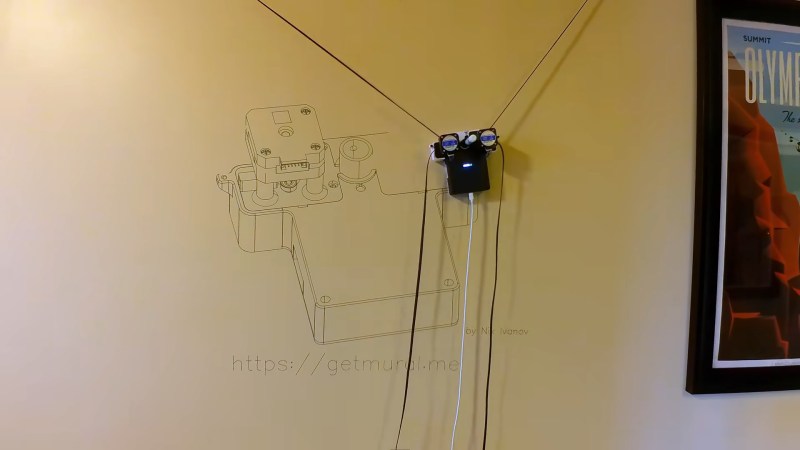
Mural 2.0 Uses a Ceiling-Anchored Belt to Draw Large-Scale Wall Art
Nik Ivanov’s Mural 2.0 is an improved large-format wall plotter with an ESP32-based FluidNC board, TMC2209 drivers and two NEMA 17 pancake steppers. A ceiling-anchored belt lets the motors pull the machine against gravity, but the geometry sacrifices about 20% of edge area. The Wi-Fi interface accepts SVG and raster images, estimates path length and offers two fill styles. Markers can weaken after roughly 500 m of line; a pause-and-replace routine is still in development.
The build provides concrete mechanical and control details for a wall plotter, while noting edge-area and marker-life limits; pen-replacement automation is not yet implemented.
2026
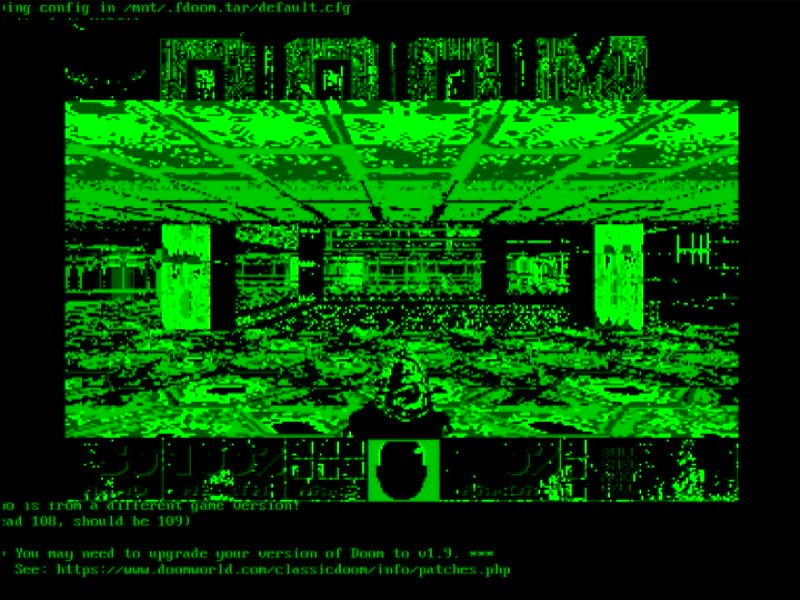
Hacker Reverse-Engineers Firmware to Boot Linux on a FortiGate 60
A salvaged Fortinet FortiGate 60 contains a VIA C3 processor running at 400 MHz and 128 MB of soldered SDRAM. The project reverse-engineered the original firmware to determine how to initialize that memory, then made further changes that let Linux 2.4 boot. DOOM ran using the framebuffer, though the reported VGA output showed only green because only the green pin was probed. The firewall also has an internal IDE interface and CF card slot; adding physical connectors to board pads is described as a possibility, not a completed modification.
The report documents firmware reverse-engineering and a Linux boot on repurposed hardware, but the system is an older, constrained board and the reported VGA test was limited.

Echo Studio Uses Infrared Gestures to Trigger Desktop Drum Loops
Tech AK’s Echo Studio is a touchless drum-looping build described on Hackster. An FC-51 infrared sensor detects hand taps and movements; an Arduino UNO R4 WiFi reads it and drives a passive piezo buzzer, while a joystick changes loop layers and parameters. Its frame uses 6 mm plywood, wiring channels and screw-mounted brackets. The supplied report gives no performance test results.
The project has concrete hardware and fabrication details, but the supplied report provides no independent performance testing or evidence of wider impact.
ESP32 and NOVA20 Build Scans a Room in Live 2D and 3D
Christopher (cgwaltney) shared a LiDAR scanner project pairing an ESP32 with Benewake’s NOVA20 multi-point sensor. The ESP32 reads the sensor, while distance data is rendered live in 2D and 3D so a room’s shape appears during scanning; the post says an accompanying video shows it running. The article provides no wiring or code, measurements, or independent performance validation.
The post documents a concrete ESP32/NOVA20 scanner with live 2D/3D output, but provides no implementation details or independent performance measurements.

PicoCentrifuge: A Raspberry Pi Pico DIY Centrifuge Build
Maker Thomas presents PicoCentrifuge, a roughly $50 DIY centrifuge using a Raspberry Pi Pico, a drone motor and 3D-printed parts. The post says the project includes open-source code, hardware files and a bill of materials, and cites $800–$3,000 used centrifuges as a comparison. Its status is not fully clear: the roundup calls it built, while the project description says construction is underway; no performance test results are provided.
The project describes a concrete centrifuge build using a Pico, drone motor and 3D printing, with files and a BOM reported. Its build status is inconsistent in the supplied text, and test evidence is absent.

Stellar Pendant Turns a 240×240 Touchscreen into a Docked PC Second Display
Ai-Thinker-AiPi’s Stellar Pendant is a lanyard-worn 240×240 touchscreen that acts as a PC second display when docked. Its reported design uses a BL618-based Ai-M61, an 8-bit parallel display bus, a 150 mAh cell and a five-pin magnetic dock for charging, USB data and serial debugging; the dock hub supports simultaneous console and data connections. Firmware, phone and desktop apps share a frame format. The panel and module are discontinued, making the build difficult.
The project provides concrete wearable-display architecture and interface details, but it is difficult to reproduce because key parts are discontinued; the supplied material includes no independent performance validation.

Raspberry Pi Project Uses MCP to Connect LLM Agents with Room Sensors
Francesco Azzola’s project connects an LLM agent to room sensors through a Raspberry Pi and MCP. An ESP32 reads an ENS160 air-quality sensor and MPU6050 motion sensor, drives a WS2812B ring, and sends newline-delimited JSON over USB. The Pi exposes semantic room-description tools and a camera JPEG resource; the architecture is implemented in the open-source PHOS robotics project. No performance results are given.
The report describes a concrete Raspberry Pi, ESP32, sensor and MCP integration, but provides no measured performance results or independent validation.
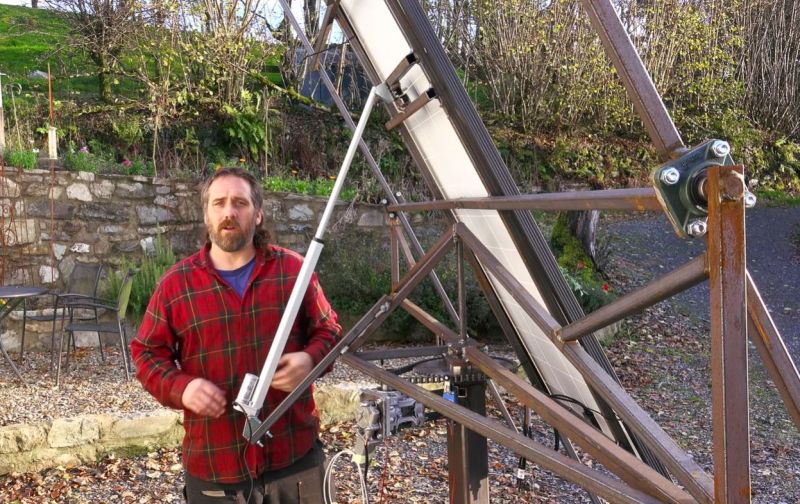
A Budget Two-Axis Solar Tracker Uses a Trailer Hub and Simple Sensors
Greenhill Forge’s two-axis solar tracker uses a trailer axle hub instead of an expensive slewing bearing, with a welded steel frame, geared motor and worm-drive linear motor. Its electronics include a wind sensor, four-photoresistor light sensor and limit switches. In a reported two-day comparison with an identical stationary panel and charge controller, the tracker produced 30–50% more energy; the article notes that the motors’ power use must be subtracted, and the short test does not establish longer-term performance.
The report describes a practical tracker build and a two-day panel comparison, but the energy gain is brief and the motor draw must be deducted; no longer-term validation is given.

MakoTalk Brings Offline Japanese Speech Synthesis to the ESP32-S3
MakoTalk 2.1.2 is an Arduino library for offline Japanese speech on ESP32-S3: kana text becomes audio over I2S, with a voice dictionary selected and speech triggered by mspeak(). Its default Zundamon voice is built from 123 sound segments. The article notes a constraint: on a 4MB board, the Default partition provides about 1.2MB for the app, less than the roughly 1.56MB sample. Installation is through an Arduino IDE ZIP; commercial use requires prior permission.
The article describes a concrete offline ESP32-S3-to-I2S speech workflow and version details, but the voice sample exceeds the stated default partition space and no independent performance test is reported.

Independent Rust Firmware Brings Linux 6.12 to Rigol DHO800/DHO900 Scopes
OOS, an independent project by dekajoule, replaces the software on Rigol DHO800/DHO900 oscilloscopes with a Linux 6.12 kernel and a Rust scope application. It runs from the instrument’s SD card alongside the factory system, which can be selected again at startup. The application is described as supporting acquisition, triggering, measurements, protocol decoding and remote control. Testing remains limited: it has run on a DHO924S and is reported by one user to run on a DHO804; some functions lack real-hardware testing, measurements are not calibrated to a standard, and installation begins with a full factory-card backup.
This is a concrete alternative firmware project with a broad oscilloscope feature set, but testing is limited, some functions remain untested on hardware, and measurements are not calibrated.

floppy3.5 Turns 3.5-Inch Floppy Disks into a Portable Wi-Fi NAS
Maker bigcrimping built floppy3.5, a battery-powered Wi-Fi NAS for reading 3.5-inch FAT12 floppy disks, including media from older digital cameras. It presents files from a disk’s root folder on a web page and can copy them to microSD. A custom PCB pairs an RP2354A running a reworked Greaseweazle firmware port with an ESP32-S3 bridge; the device also tracks 80-cylinder disks on an LCD and uses SHA-256 to avoid recopying files. Firmware, PCB files and the 3D-printed enclosure are published under the Unlicense. The report gives no independent performance testing.
The report describes a working, technically detailed archival device and releases its design files, though its operation and performance are not independently tested in the supplied material.
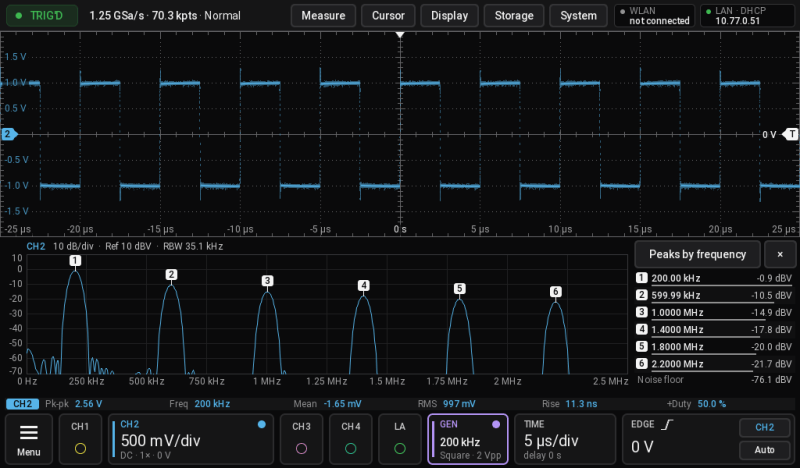
OOS Brings Alternative Firmware to Rigol DHO Oscilloscopes
Developer dekajoule is working on OOS, alternative firmware for Rigol’s DHO-series oscilloscopes. The report says it runs from the scopes’ built-in SD card alongside the stock operating system, with installation options including opening the scope to clone the card or using ADB over the network. The project is new and has been tested on only a couple of models; the article provides no independent performance results.
OOS offers concrete firmware installation options for DHO scopes, but the project is early and has been tested on only a couple of models.
DiPlay Brings USB and Wireless CarPlay to Android Head Units
DiPlay is described as a free, open-source CarPlay receiver for Android head units. After APK installation, an iPhone can connect by USB or wirelessly to show maps, music, calls and Siri on the car display. The article outlines setup and adjustable image settings. The app is in public preview, with testing focused on some Android head units and BYD DiLink; compatibility may vary by model, Android version and firmware. Performance claims are not independently verified.
The article gives a named app and practical installation and USB/Wi-Fi connection steps for car head units; it is a public preview, and compatibility and performance are not independently established.
SO-ARM101 Troubleshooting Guide Covers Setup, Calibration and LeRobot Deployment
Seeed Studio’s guide organizes SO-ARM101 and LeRobot troubleshooting from power and wiring through serial ports, servo setup, calibration, cameras, data collection, training dependencies and real-robot inference. It gives concrete checks, including 7.4 V Leader servos, kit-dependent 7.4 V or 12 V Follower servos, and a 2048 servo midpoint. The article is practical guidance, not an independently tested performance report; commands and dependencies may vary by repository version.
The guide provides specific, actionable robot-arm setup and debugging steps. Its recommendations are not independent test results, and some instructions depend on the kit and software version.
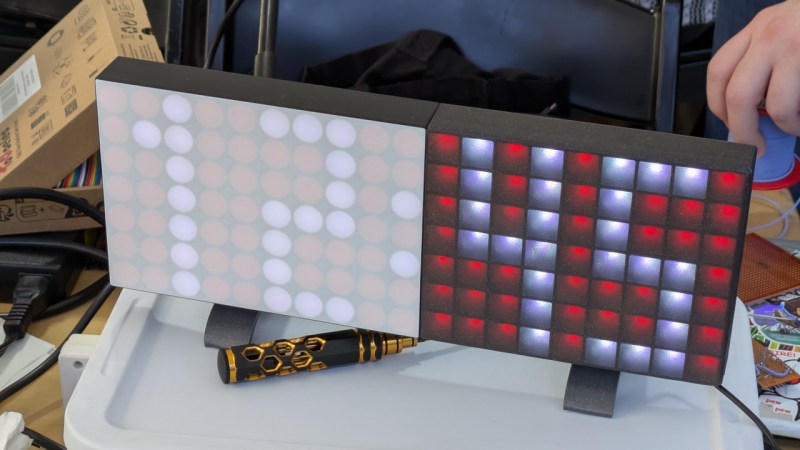
PixelClock Routes an LED Strip Through a 3D-Printed Frame
Hackaday reports that Dom Dominici’s PixelClock routes a continuous 2.5-meter WS2812B strip through a 3D-printed frame to make a 7×19 display, avoiding individual LED wiring, though some LEDs are hidden in the folds. An ESP32 WROOM controls it; setup uses a web interface and firmware can be installed via WebSerial. The printed diffuser supports filament color changes and CAD customization. The article says it saw the clock in person but gives no quantified performance tests.
The article describes a concrete LED-clock assembly method and ESP32 setup; it provides no measured performance data, so broader performance claims remain unverified.
CHRIC Opens RW-02OP Full-Scale Wheel-Legged Robot Platform for Research
An independent explainer says Chengdu Humanoid Robotics Innovation Center released RW-02OP in February 2026 as an open full-scale wheel-legged research platform. It reports 1.1 m height, 21 kg mass and a 10 kg rated payload, with CAD, BOM, MuJoCo and ROS/control materials. Performance claims are not independently verified. Replication reportedly costs tens of thousands of yuan and requires robotics skills; it is not a ready-made or weatherproof commercial robot.
The article provides project-specific replication and body-modification guidance alongside CAD, BOM and control materials; reported payload and performance are unverified, and building it requires substantial cost and robotics skills.
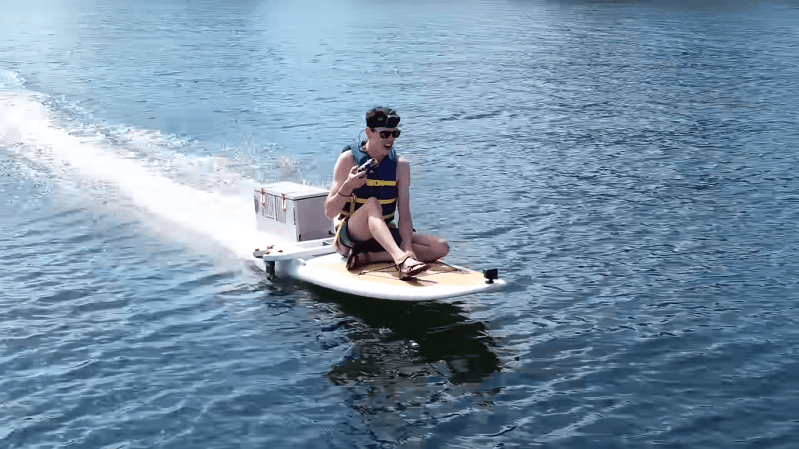
A Custom Twin-Motor Paddleboard Is Reported to Exceed 40 km/h
Hackaday describes a custom motorized paddleboard built by [rctestflight], using two masts reused from a prior hydrofoil project, a 6 kW electric motor at the end of each mast, batteries in a waterproof case and remote control. The article says custom propellers were refined through repeated tests and that the board can plane with the rider positioned forward, reaching over 40 km/h. The speed and “fastest” comparison are reported, not independently verified here.
This is a specific hardware build with a twin-motor configuration and tuned custom propellers; the reported top speed and fastest-in-class comparison lack independent verification.
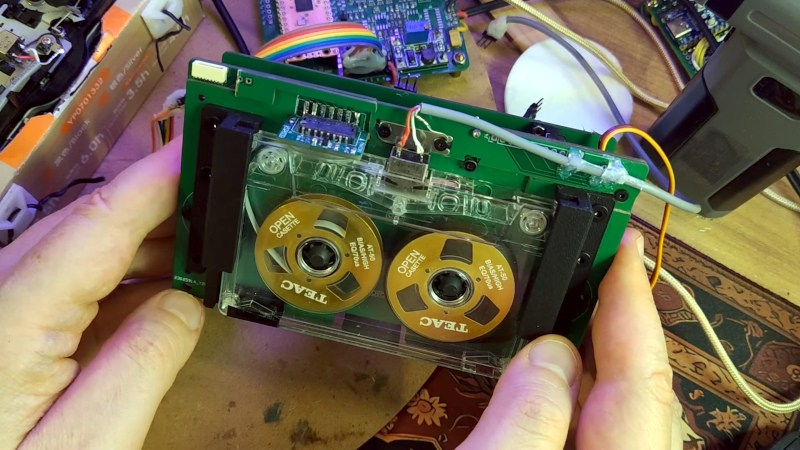
Svofski Builds a PCB-Based Cassette Mechanism for Data Tape
Svofski is building a cassette-tape mechanism from scratch, using a PCB chassis and separate brushless motors for the two spindles. Rather than a capstan, an optical mouse sensor measures tape speed and provides input for motor control. The project is intended as a data tape drive, not an audio cassette player, and the article says it is still incomplete.
The report gives concrete details of the physical build and its sensing and motor-control approach, but describes an unfinished data-tape mechanism rather than an audio player.
2026
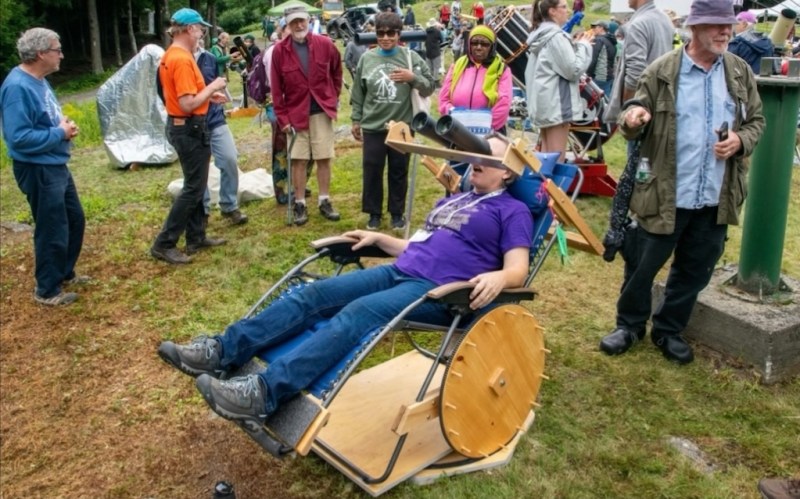
Milky Way Lounge Chair Holds Binoculars Steady for Stargazing
Dave Selinger designed the Milky Way Lounge Chair to let stargazers view at angles up to the zenith and rest their arms while binoculars hold their azimuth and altitude. The reported build starts with a zero-gravity chair mounted to a board over a rotating bearing and octagonal ground board, with leveling screws for uneven ground. The base plans are free; the binocular holder and other functions are offered for sale. The chair has no tracking capability.
This is a concrete binocular-support design with useful construction details, but the report describes a relatively niche project and notes that it cannot track the sky.

Open Duck Mini Robot Build Nears Wiring Completion
Kevin McAleer’s Open Duck mini-robot build episode focuses on wiring, with the robot’s connections described as close to finished. The update also mentions setbacks, including failed 3D prints and procrastination. The supplied article text does not provide a wiring diagram, parts list or detailed build steps, so it offers a progress update rather than enough information to reproduce the wiring.
The article reports concrete wiring progress on a physical robot, but gives few implementation details and mentions failed prints; this narrow update has limited broader value.