

A Two-Component, 3D-Printed H-Shifter for Racing Sim Setups
Reading lead
Jason has demonstrated a low-cost H-pattern shifter for driving simulators built around two electronic components: a game-controller-style joystick and an Arduino Pro Micro. The electronics use a straightforward wiring arrangement, while a prototype 3D-printed enclosure and shift knob provide the physical gate and can be shaped for a chosen H pattern. The builder also demonstrates readily available firmware with options for different shifter configurations. The project suggests a relatively simple route to adding a shifter to a DIY sim setup, but the two-part count applies to the electronics, not the complete build: it also depends on a printed case and knob. The article describes it as a prototype and provides no measured cost, durability, or performance results.
Article body
Image unavailable. Open source image ↗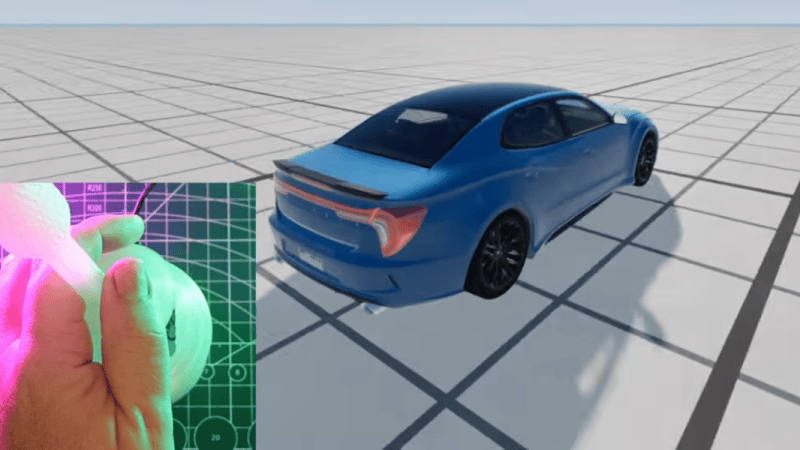
Flying and driving simulators can go as far as money will take you, and at some point it might end up being cheaper to buy a plane or race car than to keep adding capabilities to some of the sim rigs we’ve seen. But it can also be a fairly affordable hobby as well, with entry-level components being within reach for many. The price can drop precipitously from there too, provided some parts can be sourced and a 3D printer is made available, and [Jason] is demonstrating one of the lowest-cost H-shifters we’ve seen which only uses two parts at its core.
The two components only cover the electronics for the build, but this gets almost everything needed for the shifter squared away. A joystick like those found inside many game controllers is paired with an Arduino Pro Micro, with a very straightforward wiring configuration between them. These components are paired with a prototype 3D printed case and shift knob which provides the H pattern of choice. From there it’s as simple as uploading some readily-available firmware, which [Jason] also demonstrates, and which has many options for various configurations of shifters.
Although this was just a prototype, it shows was just a few off-the-shelf components and a 3D printer can provide to an affordable driving sim setup. Even then a 3D printer is not always necessary, like this three-pedal setup using extruded aluminum frame as a base. From there, all kinds of other features can be added like force feedback on the steering wheel.
Source: Bryan Cockfield ·Hackaday · 2026-10-09T20:00:03.000Z · Read the original article
Why read this
The article documents a concrete DIY shifter design using common electronics and configurable firmware; it remains a prototype, with no cost or performance testing reported.
AI score 38 · View scoring rationale
Two-model scores assess source reading value, not factual accuracy. Check this editorial article against the original.
- gpt-6-luna-2026-09-22 · 43
The article documents a concrete DIY shifter design using common electronics and configurable firmware; it remains a prototype, with no cost or performance testing reported.
- deepseek-flash · 34
A low-cost DIY sim-racing shifter prototype using an off-the-shelf joystick and Arduino Pro Micro; clearly in the hardware domain, but it is a small maker project with no pricing, testing, or production details.
Analyzed: 2026.10.10 02:34 UTC
Comments & answers 0