

All updates
2026
Hexa-Bouncer Uses Six Steppers and Vision to Keep a Ping-Pong Ball in Play
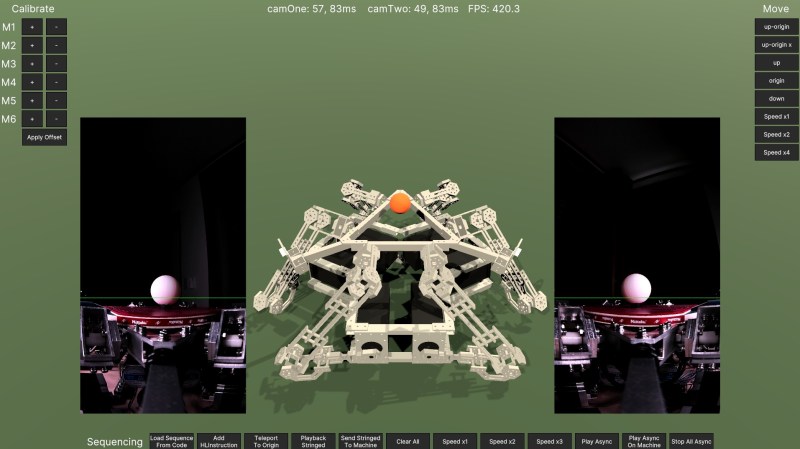
T-Kuhn’s hexa-bouncer is a custom Stewart-platform robot built to bounce a ping-pong ball, using six stepper motors with planetary gearboxes to move and orient a paddle. A Teensy 4.0 coordinates the motors, while a PC runs a Unity application that performs inverse kinematics and uses two cameras to track the ball in 3D; the application is available on GitHub. The mechanical assembly is largely CNC-milled aluminum, with more than 300 pieces overall and 27 machined parts for each arm. The article describes the build and points to video of it in operation, but gives no measured performance results. It also notes that the vision workflow builds on the creator’s earlier octo-bounce robot.
This is a concrete, unusually elaborate robotics project with a GitHub application and a described vision-and-control setup; the article offers no quantified performance validation.
2026

Security Researchers Find JIT-Based Spectre-v2 Bypass and Serious Robot Mower Flaws
A security roundup reports research suggesting that self-modifying code in just-in-time compilers can make processors use cached instructions to evade some Spectre-v2 mitigations. Researchers tested the approach against Firefox’s SpiderMonkey JavaScript engine, Linux’s eBPF JIT and GraalVM, finding it feasible in those environments; the article says this demonstrates plausibility, not an immediate widespread exploit, and notes that further mitigation research is needed. The roundup also describes vulnerabilities in Mammotion’s robot lawnmower platform: researchers reported account takeover, exposure of customer data, unauthenticated access to mower camera mode, weak account-recovery protections and hard-coded firmware tokens. They say remotely testable issues appear to have been resolved after disclosure attempts, but the account does not establish that all weaknesses were fixed. Other items cover a large Linux kernel patch list, Google pausing its open-source vulnerability rewards program amid low-quality AI-generated reports, and separate breaches involving Asos, the FBI and domain registrars.
The roundup includes technically specific JIT-based Spectre-v2 research and reported robot-mower security flaws, but the attack is described as plausible rather than widespread, and the mower fixes are not fully confirmed.
2026
NVIDIA Showcases AI Agents Building Omniverse Simulations for Robotics and AV Testing
NVIDIA describes developer experiments using frontier AI agents with Omniverse libraries to assemble and revise simulation applications through natural-language direction and human review. Examples include a humanoid warehouse simulator, an autonomous-driving workflow built around a Market Street scene, digital twins refined by comparing simulated camera and LiDAR outputs with recordings, and simulated robot sports and disassembly tasks. The article also shows agents helping create a browser-based International Space Station model and an editable room from camera captures. NVIDIA reports that a simulated Unitree G1 cleared one hurdle in 64 of 100 trials; another guided workflow took about three days to create or improve digital twins. These are company-described prototypes and experiments, not independent evaluations or evidence of production deployment. The material illustrates workflows combining models such as Astra and Claude Fable 5 with Omniverse tools, OpenUSD, Isaac Sim and other components, while developers direct the agents, assess results and make corrections.
The article documents concrete agent-assisted simulation prototypes and one reported 64/100 hurdle result, but presents NVIDIA-led experiments without independent validation or evidence of production deployment.
Arduino Reports UNO Q’s First-Year Shipments and Expanding Developer Ecosystem
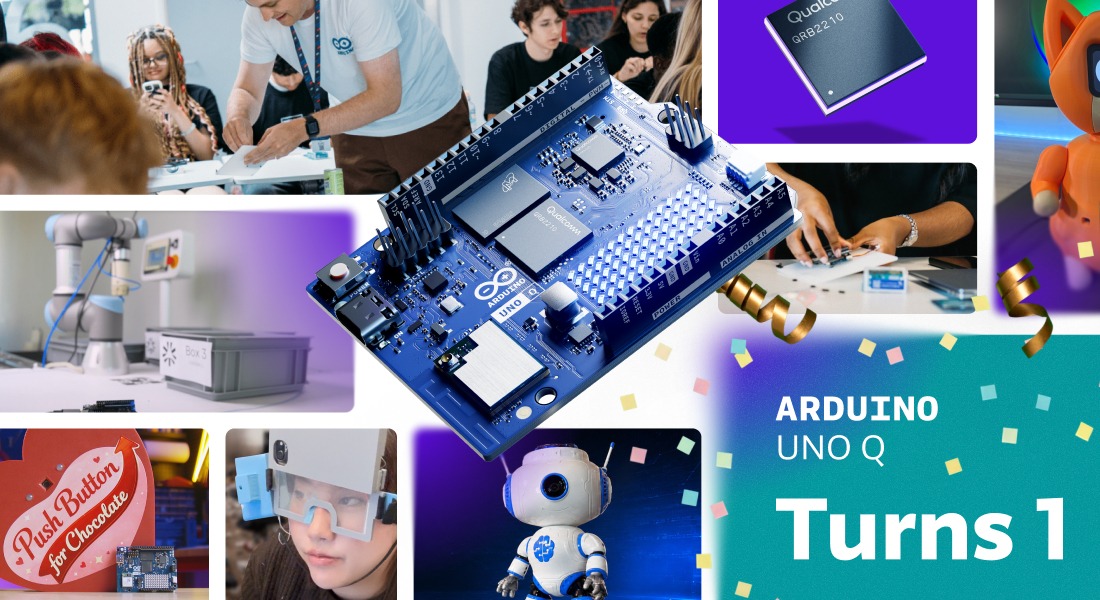
Arduino’s one-year retrospective says more than 270,000 UNO Q boards had shipped worldwide by September 29, 2026, alongside 400-plus events, over 4,000 contest participants and more than 850 forum topics. The company also reports year-on-year growth in Project Hub projects and Arduino library downloads, which reached 244 million in the past 12 months, versus 165 million the year before; Arduino IDE downloads reached 35 million. The post recaps UNO Q’s combination of a Qualcomm Dragonwing QRB2210 Linux-capable processor with AI acceleration and an STM32U585 real-time microcontroller, plus the App Lab workflow pairing Arduino sketches with Python applications. Arduino says App Lab is on GitHub and describes software, partner and deployment pathways intended to help move projects toward production. These are company-reported adoption figures and claims, not independently audited measures; the article is a retrospective rather than a new product announcement.
The post provides concrete company-reported UNO Q shipment and ecosystem figures and recaps its dual-processor design; adoption data are not independently verified, and no new product is announced.