

All updates
2026
Sophos Says OpenAI Daybreak Agents Resolve 52% of MDR Cases End-to-End
Sophos describes deploying agents built with OpenAI Daybreak within its Fusion cyber defense system, including its Managed Detection and Response service. The system draws on data from more than 500 third-party integrations and Sophos products, processing trillions of events daily into roughly 1,000–2,000 cases for investigation. Sophos says agents gather customer context and threat indicators, plan and conduct investigations, and prepare recommended actions for analysts; other agents can perform parts of the response. The company reports average response time of 89 seconds for cases using agents, compared with about 38 minutes previously, and says AI resolves 52% of MDR cases end-to-end within analyst-defined boundaries. Customers can choose notify, collaborate, or authorize modes, and the company says potentially destructive actions retain appropriate human oversight. These figures are company-reported; the material provides no independent validation or detailed methodology.
The report gives concrete deployment metrics and describes human-control modes, but results are Sophos-reported and lack independent validation or detailed measurement methodology.
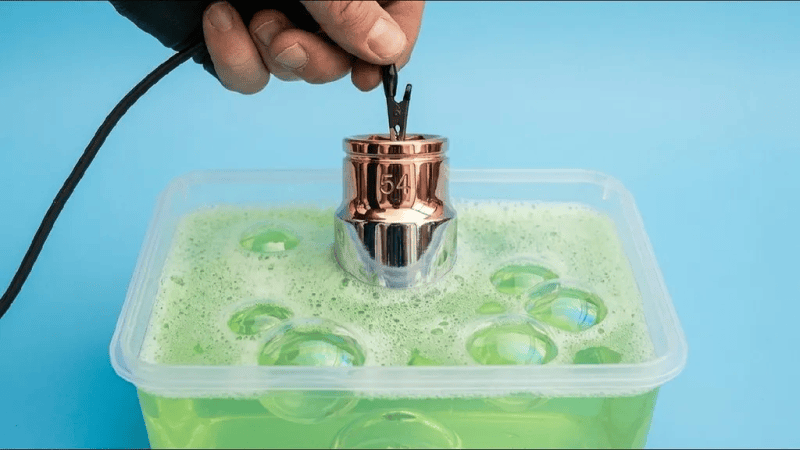
A DIY Guide to Mirror-Finish Nickel Plating for Tools
The article describes [Kovancapol]’s process for applying a mirror-finish nickel coating to tools. It notes that the setup involves nickel sulfate and nickel chloride, glassware, nickel anodes, and a power supply, and points to a video in which the plated results appear visually polished. The piece presents electroplating as a process that may become more approachable once the equipment and materials are assembled, but it does not provide quantified coating performance, durability testing, or detailed operating parameters in the supplied text. It also raises possible applications, such as coating conductive 3D prints, as speculation rather than demonstrated results. Using nickel on PCB traces may be impractical because oxidized nickel is difficult to solder. The article mentions combining plating finishes but offers no specific tested examples.
This is a practical hardware-related plating demonstration with visible results, but the supplied text gives no measured performance or detailed procedure, and some applications are speculative.
Jetson Orin Boot-Log Guide Maps Startup Stages to Troubleshooting Checks
A Seeed Studio technical article walks through a Jetson Orin UART boot log to explain the path from power-on to Ubuntu and how to use the last successfully reached stage to narrow down failures. It outlines BootROM/PSCROM, MB1, MB2, security firmware, UEFI, L4TLauncher, the Linux kernel, initramfs, storage discovery, the Ubuntu root filesystem, and systemd. Log markers such as “SDRAM initialized,” UEFI startup, “Linux version,” NVMe enumeration, and the root-filesystem mount indicate which parts of the chain have completed. The guide links these checkpoints to likely areas to inspect: early-stage board, memory, power, or configuration issues; UEFI handoff and boot files; or, later, kernel, storage, PARTUUID, and filesystem problems. It cautions that an error or warning does not necessarily mean the whole boot failed, using a camera-probe error as an example. This is a practical diagnostic walkthrough, not a new Jetson release or an independently validated performance test.
The article provides a concrete, stage-by-stage UART log troubleshooting method for Jetson Orin; its value is practical guidance, not a product change or independently tested result.
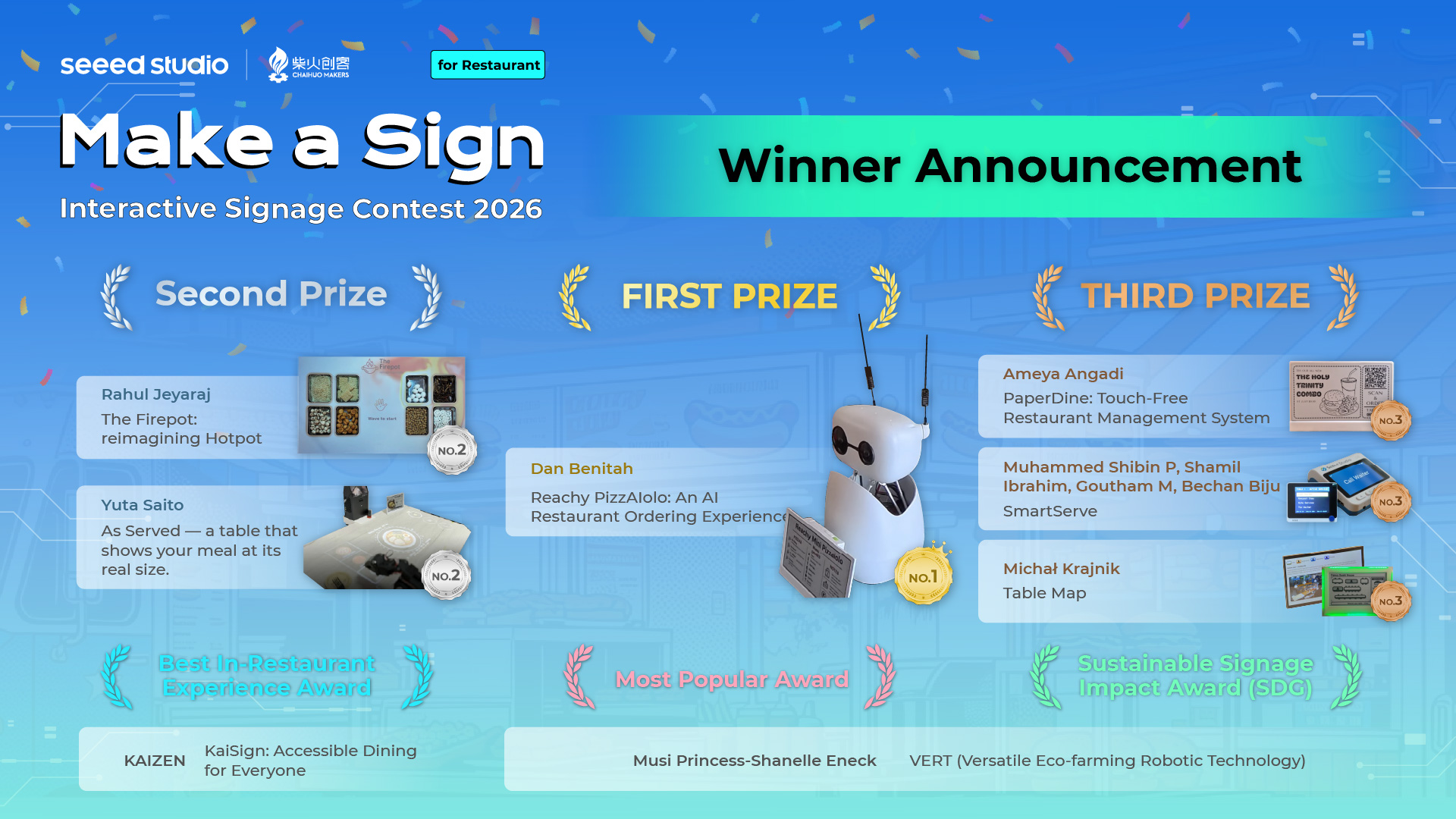
Seeed Names Nine Winners of Its 2026 Interactive Signage Contest
Seeed Studio reports that its second Interactive Signage Contest drew 156 makers from 23 countries and selected 121 qualified projects, with nine winning projects spanning restaurant ordering, accessibility, sustainability and other applications. First prize went to Reachy PizzAIolo, a prototype pairing Reachy Mini Lite with a reTerminal E1003 for voice-based ordering, live order review and handoff to restaurant staff; the article says it was also used at a pizza party. Other projects include a real-size projected menu with a robotic utensil arm, a hotpot counter using eight load cells for live pricing, touch-free restaurant tools, an AI-based table map, accessible ordering through touch, ASL and voice, and an automated greenhouse. These are contest project descriptions, not independent evaluations or evidence of commercial deployment. The company says the winners are planned for display at Maker Faire Shenzhen on December 12–13, 2026, and that it will support selected projects as they develop.
The concrete news is the contest’s nine selected projects, including a voice-ordering prototype and several hardware-based systems. Claims are organizer descriptions; broader deployment and performance are not independently established.
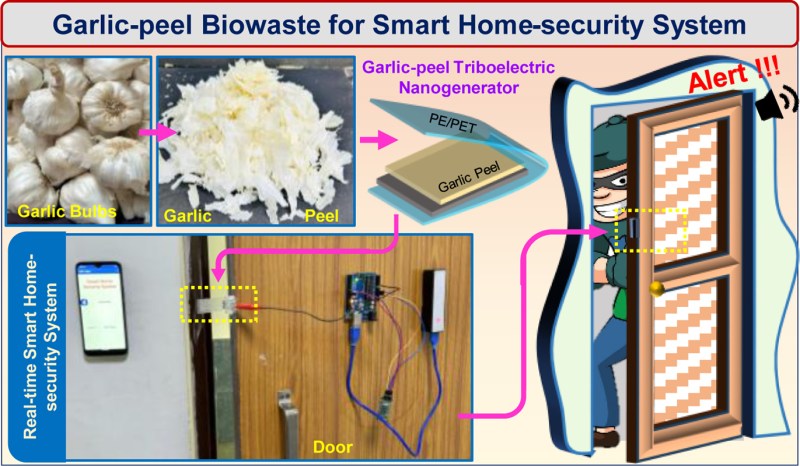
Garlic-Peel Triboelectric Sensor Generates Power When a Door Opens
Researchers Manas Tiwari and Deepak Bharti developed a door-and-window sensor based on a triboelectric nanogenerator, using ground garlic peel as the positive material and polyethylene as the negative layer. The article reports that opening a door produced about 210 volts AC at a short-circuit current of 45 microamps; a two-sided garlic-peel layer raised the reported output to 400 volts AC and 65 microamps. In the described setup, a separate microcontroller detected the generated current but ran from a power bank, so the demonstration did not eliminate the need for an external power source. The authors suggest the harvested energy might support a brief low-power wireless transmission, but that use is presented as a possibility, not a demonstrated result. The sensor reportedly remained functional after six months in storage and 200 stress cycles. The underlying research paper is paywalled, and the article provides no independent validation or detailed performance data.
The material describes a specific garlic-peel energy-harvesting sensor and reports output and durability figures, but its demonstrated MCU still needs a power bank and the research paper is paywalled.
ttok 1.0 Defaults to the GPT-5 Tokenizer, With GPT-6 Similarity Still Unconfirmed
Simon Willison has released ttok 1.0, changing the tokenizer selected by default after noticing that version 0.4 defaulted to the GPT-4 tokenizer. The release is presented as a practical correction to align the default with the GPT-5 family and GPT-6. OpenAI has not confirmed that GPT-6 uses the same tokenizer as GPT-5. The article cites an experiment reported in a commit by William Liu: seven model variants—GPT-5.5, GPT-5.6 Sol/Terra/Luna and GPT-6 Astra/Sol/Luna—each produced 44,794 tokens and matched across 31 test fixtures. That result suggests no input-count difference on this particular corpus, but it is limited evidence rather than official confirmation or a broad independent evaluation. The material does not describe other changes in ttok 1.0.
The release changes ttok’s default tokenizer, and a cited 31-fixture test found matching counts across seven models; OpenAI has not confirmed GPT-6 tokenizer parity, and the test is limited.

Free 3D-Printable Gothic Skull Lamp Uses Bambu’s MH001 LED Kit
Maker BattCave has shared files for a gothic skull-shaped USB LED lamp designed around the Bambu LED Lamp Kit MH001. The model uses a threaded base intended to simplify assembly, and colored gel films can be added to change the skull’s appearance. The listed print settings are 0.2 mm layers, three walls and 10% infill, with an estimated 17.6-hour print on one plate; PLA is recommended, and the showcased example uses Sunlu Matte White. The files are available on MakerWorld. The article presents the design and its suggested setup, but provides no independent measurements of brightness, print quality or assembly performance.
This is a usable, downloadable 3D-print design with specific print settings, but it is a single hobby lamp model and its illumination claims are not independently tested.
2026

Free 3D-Printable Skull Candle Nightlight Uses LED Strings or Tea Lights
Maker Mad_Power has shared a 3D-printable skull-shaped nightlight designed to resemble a melting candle. The project is intended as a Halloween decoration for a home or desk and is described as compatible with standard LED string lights as well as typical tea-light fixtures. The model can be printed using FDM in different colors, allowing users to vary its appearance. The article links to downloadable files on MakerWorld. It does not provide print settings, dimensions, electrical details, testing, or evidence about fit across specific light products, so those practical details cannot be confirmed from the supplied material.
The concrete item is a downloadable, FDM-printable decorative light with two stated lighting options; its novelty and practical scope are limited, and no technical specifications or compatibility testing are provided.
NVIDIA Showcases AI Agents Building Omniverse Simulations for Robotics and AV Testing
NVIDIA describes developer experiments using frontier AI agents with Omniverse libraries to assemble and revise simulation applications through natural-language direction and human review. Examples include a humanoid warehouse simulator, an autonomous-driving workflow built around a Market Street scene, digital twins refined by comparing simulated camera and LiDAR outputs with recordings, and simulated robot sports and disassembly tasks. The article also shows agents helping create a browser-based International Space Station model and an editable room from camera captures. NVIDIA reports that a simulated Unitree G1 cleared one hurdle in 64 of 100 trials; another guided workflow took about three days to create or improve digital twins. These are company-described prototypes and experiments, not independent evaluations or evidence of production deployment. The material illustrates workflows combining models such as Astra and Claude Fable 5 with Omniverse tools, OpenUSD, Isaac Sim and other components, while developers direct the agents, assess results and make corrections.
The article documents concrete agent-assisted simulation prototypes and one reported 64/100 hurdle result, but presents NVIDIA-led experiments without independent validation or evidence of production deployment.
Carson Gross Argues That Programming Skills Will Remain Valuable Alongside AI
A brief post by Simon Willison quotes Carson Gross on the future of programming careers in the age of AI tools. Gross describes programming as combining problem-solving with computers and managing the complexity of solutions. He says he finds it difficult to imagine those capabilities becoming less valuable, and therefore expects programming to remain a viable career despite the advent of AI tools. The post offers a concise opinion rather than new empirical evidence: it provides no data, examples, or analysis of how AI is changing programming work.
This is a relevant career perspective on AI and programming, but it is a short quoted opinion without supporting data or evidence of a concrete industry change.

DIY Chromalux Lamp Combines a 3D-Printed Shade with Addressable LEDs
The featured Chromalux project, shared by luxellights on MakerWorld, is a DIY RGB lamp combining a 3D-printed base with interchangeable shade designs. Its listed electronics are an ESP8266 controller and six WS2812B LED-strip sections, each with 12 LEDs, for about 72 LEDs in total. The design calls for roughly 1.5 meters of strip with a width of 10 mm or less, and the post says a 5V, 2A USB charger is sufficient. It uses WLED firmware, installed through install.wled.me, and is configured as six segments. The project files are offered under a CC BY-NC license. The material describes a maker build and its components, not independent testing or a newly released commercial product; it provides no measured brightness, operating results, or detailed build instructions in the supplied text.
A concrete, replicable maker lamp specifies its controller, LEDs, power, and WLED setup; the material gives no independent performance tests and is not a commercial launch.
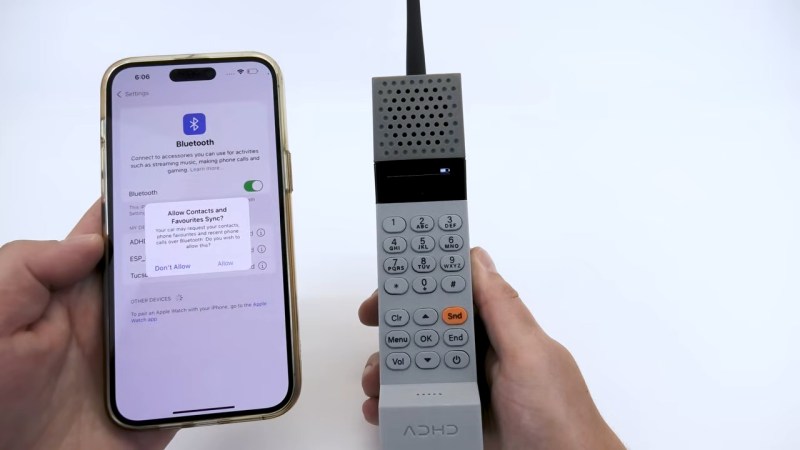
Maker Builds a Retro Bluetooth Handset to Reduce Smartphone Distractions
Kevin Noki has built a retro-styled Bluetooth handset as an alternative way to handle calls without picking up a smartphone. The device is not a standalone cellular phone: it pairs with a separate, professionally approved phone, since the build has no cellular modem and custom hardware access to VoLTE is difficult in many places. Noki initially used an ESP32, but switched to a dedicated Bluetooth Hands Free Profile module after finding the audio quality too poor. The project video shows a case-design process that uses XPS foam and a hand-operated hot-wire cutter for quick form iterations, followed by a single 3D-printed final case; a simple jig is used to bend the dark acrylic covering the display. The design is offered on Noki’s website, while the article says the on-screen details may be enough for others to reproduce it without purchasing the design. The handset can reduce the need to interact directly with a phone, but does not replace one.
The project demonstrates a concrete Bluetooth handset build and practical fabrication choices, but it depends on a separate phone and does not provide cellular service or independently verified performance.

Three 3D-Printable Tombstone Tea-Light Holders Use a Fuzzy-Skin Finish
Maxx_Design has shared a set of three tombstone-shaped tea-light holders intended for 3D printing, with an alternative design that omits crosses. The holders are described as fitting round tea lights up to 40 mm in diameter and use a two-piece construction. The print guidance specifies orienting the tombstones at a 45-degree angle; the base plates use 150% flow and a Hilbert-curve pattern to create the fuzzy top texture. The lower portions of the stones should be printed without fuzzy skin so the parts fit together properly. The files include preconfigured profiles with custom fuzzy-skin settings and manual supports. The material also notes a commercial license via Patreon, but does not provide print-test results or further details on licensing terms.
The concrete contribution is a downloadable 3D-printable design set with fit and print-setting details; its value is mainly a niche seasonal maker project, with no performance testing reported.

John Park’s Workshop Announces Its Regular Live Maker Show for October 8
Adafruit’s post announces that John Park’s Workshop will stream live on October 8 at its usual time of 4 p.m. ET / 1 p.m. PT, with text chat in the Adafruit Discord. It says the video will be available on YouTube Live, Twitch, Periscope (Twitter), and Facebook. The weekly program features John Park building, demonstrating, hacking, and modifying projects, and may cover topics such as CircuitPython, tools, retro gear, and projects using digital fabrication, hand and power tools, and microcontrollers. The post is a schedule reminder, not a new product or technical development; it provides no specific episode project details or performance evidence.
The post gives a date, time, chat location, and streaming platforms for a recurring maker show, but reports no new project or technical result.

3D-Printed Mobile Case Combines Raspberry Pi Zero W, LiPo Battery and USB-C Charging
A maker-designed 3D-printed enclosure for Raspberry Pi Zero W projects is presented as a compact option for portable builds. The case is described as accommodating the board, a 2000mAh LiPo battery and a 5V USB boost converter. Listed features include a USB-C charging input, access to the microSD card and an MN1 physical power switch intended for safe shutdown; the design is also described as having a close fit and limited cable-management needs. STL files are included, making the enclosure design available for printing. The article does not provide independent testing, dimensions, battery runtime, charging details or evidence for its suggested mobile and low-power uses, so those capabilities should be treated as design claims rather than verified performance.
The concrete contribution is a printable enclosure design with specified power components and access features. The article supplies no measurements or performance testing to validate its portability or operation.

BIGWORDS.PAGE Turns a URL into a Lightweight Digital Signage Display
BIGWORDS.PAGE, a web project by SpeakingOfBrad, lets users create text displays by encoding content and styling options in a URL, then sharing that link with browsers on other devices. The article describes support for text, font and text colors, images, countdown timers, and animated presentations spanning multiple pages. A visual editor can generate a finished link, while the URL format can also be assembled manually. The project is released under the MIT license, and its documentation explains how to self-host it, including for displays on a local network that should not each connect to the public internet. The material presents this as a simple browser-based way to distribute display content; it does not provide independent testing, deployment scale, or performance data.
This is a usable, MIT-licensed browser signage project with several content modes and self-hosting instructions, but the article offers no independent testing or evidence of broader deployment.

Two Lightweight 3D-Printed Headbands Offer Quick Halloween Costume Props
The article highlights two 3D-printable Halloween headband designs shared by themapster: a witch-hat headband and a knife-through-the-head prop. The supplied material lists estimated print times of 50 minutes and 27 minutes, respectively, and describes the designs as lightweight and requiring little filament. It says multiple print profiles are available for either filament color changes or single-color prints, and that the designer plans to add more designs. Files are linked on MakerWorld. The article provides no independent testing or details on printer settings, material requirements, fit, or safety; the 5.0/5 rating mentioned for the witch-hat design is not accompanied by rating volume or verification.
This is a small, concrete 3D-printable prop release with stated print times and linked files; its limited scope and lack of independent validation keep its broader value modest.

Articulated Rexagon Combines T-Rex and Dragon Features in a Support-Free 3D Print
PinkyWings’ Articulated Rexagon is a poseable flexi model combining T-Rex and dragon characteristics. The model is offered in two-color and three-color versions and is designed to print without support structures. The supplied material lists print times of 1.6 to 5.9 hours depending on the variant, with optimized profiles for Bambu A1, X1, H2D, and P1S printers. A dedicated two-color H2D version is listed at 1.6 hours. Suggested settings are a 0.2 mm layer height, two walls, and 5% infill. The article describes this as a return of a non-Halloween flexi to the lineup; it does not provide independent print testing. Commercial use requires Patreon membership.
This is a specific, usable 3D-print model with printer profiles and settings, but the article offers no independent validation and the release is a niche design.

DSPi Brings Multichannel Audio DSP to Raspberry Pi Pico and Pico 2
Weeb Labs has published DSPi, GPL v3 firmware that configures the Raspberry Pi Pico (RP2040) and Pico 2 (RP2350) as USB sound cards with onboard digital signal processing. Listed functions include room correction, active crossovers, parametric equalization, time alignment, loudness compensation and headphone crossfeed. Both boards run at a fixed 307.2 MHz clock, selected to keep PIO dividers integer at 44.1, 48 and 96 kHz; the RP2040 requires a small voltage increase. The article says the RP2350’s hardware floating-point unit gives it capacity for 11 channels and 9 outputs, compared with 7 channels and 5 outputs on RP2040. Output slots can switch between S/PDIF and I2S at runtime, with both formats usable on one device. Pin assignments can be changed without reflashing and saved in one of ten presets. A Core 1 delta-sigma modulator provides a PDM subwoofer output through a simple RC low-pass filter. The firmware builds with the standard Pico C/C++ toolchain; the article provides no independent performance measurements.
This is a concrete open-source firmware release with configurable multichannel DSP and interface options; the article gives feature and channel counts but no independent performance testing.

Three Printable Halloween Tombstone Designs Offer Quick Maker-Themed Decorations
A featured MakerWorld upload by tim_hrt offers three small 3D-printable tombstone designs with humorous inscriptions, including “RIP My Filament Supply,” “Game Over” and “R.I.P.” The supplied article lists estimated print times of 49 minutes, one hour and 1.1 hours, respectively, and says each design fits on one plate and requires minimal supports. It also reports a 5.0-star rating for all three designs, though no rating counts or independent print tests are provided. The files are presented as tabletop or desk decorations for Halloween, with the filament-themed wording aimed at 3D-printing enthusiasts. This is a small seasonal design feature rather than a new printer, material or printing technique.
The post identifies three downloadable designs and gives print-time estimates, but this is a modest seasonal project feature with no independent validation or broader technical advance.