

All updates
Publish
2026
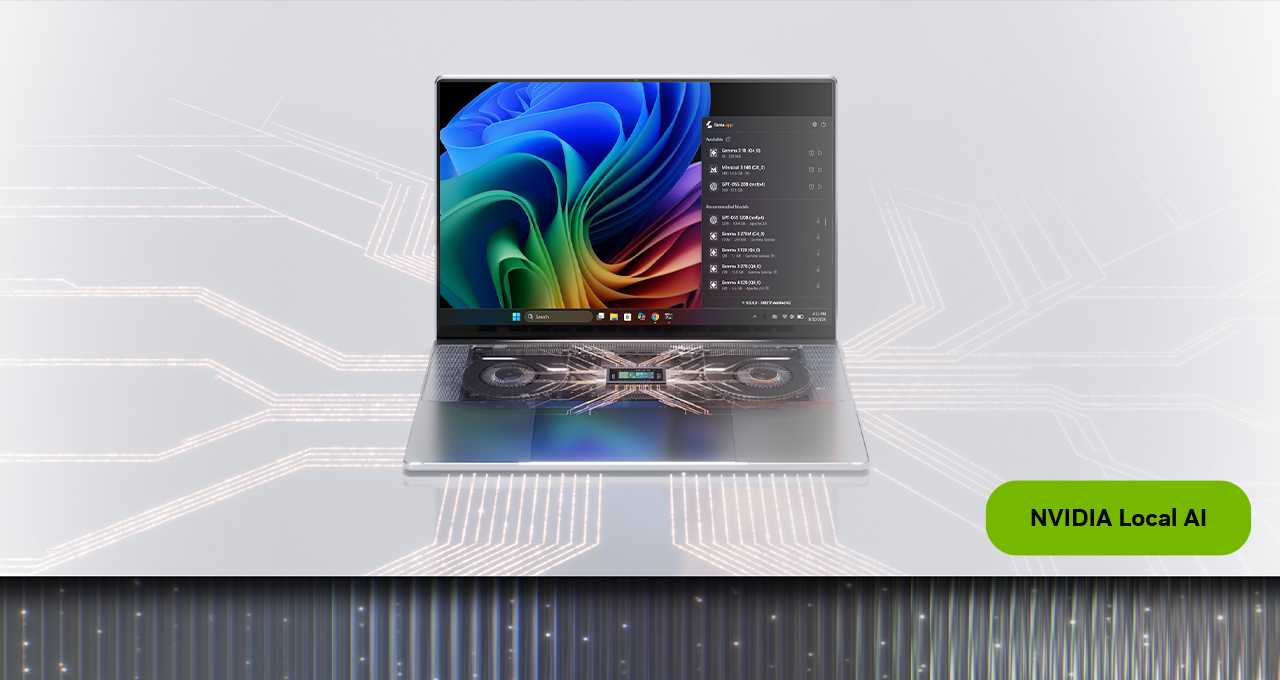
NVIDIA Details Local AI and Software Updates Ahead of RTX Spark Laptop Launch
NVIDIA says RTX Spark laptops are due to launch October 16, accompanied by a broad set of software and ecosystem updates for local AI, creative work, development and gaming. The announcements include Nemotron 3.5 Bolt 74B, a 74-billion-parameter mixture-of-experts model with 9 billion active parameters, quantized to fit in 24GB; NVIDIA PAIR’s exit from beta with llama.cpp support; and new agent setup, security and local/cloud routing integrations. Other updates include Broadcast 2.3, RTX Video features in ComfyUI, Windows on Arm developer packages, a llama.cpp Windows app and DLSS 5 support. NVIDIA reports that Adobe’s RTX Spark optimizations are intended to deliver up to twice the performance in selected workflows, but availability is phased, with some features still in beta or scheduled for later releases. The performance claims and platform details are presented by NVIDIA and are not independently validated in the supplied material.
This is a substantial, specific ecosystem update tied to an imminent laptop launch, with new local-AI tools and integrations; performance claims are NVIDIA’s, and several features are still upcoming or in beta.

NVIDIA Announces Planned Investments in Four French AI and Technology Startups
NVIDIA says it has announced planned investments in four companies in France: healthcare technology firm Doctolib, materials-discovery startup Entalpic, robotics developer Genesis AI and business-planning software company Pigment. The announcement is part of a broader account of French deployments using NVIDIA technology, rather than a detailed investment disclosure: it gives no amounts, terms or closing timelines for the four planned investments. The post also describes Bull’s plan to extend European AI server production to Vera Rubin Ultra NVL72 systems in 2028, and reports that Altair-1, a satellite using NVIDIA Jetson AGX Orin modules, has reached orbit. Other examples include a public-sector digital twin that the article says has reduced operating costs by 10%, and marketplace catalog processing that it says takes under two hours. These are company-reported examples; the material does not provide independent validation or comparable methodology for the performance claims.
The concrete news is planned investment in four France-based companies, alongside examples of deployments; investment amounts and terms are undisclosed, and performance figures are company-reported.
2026
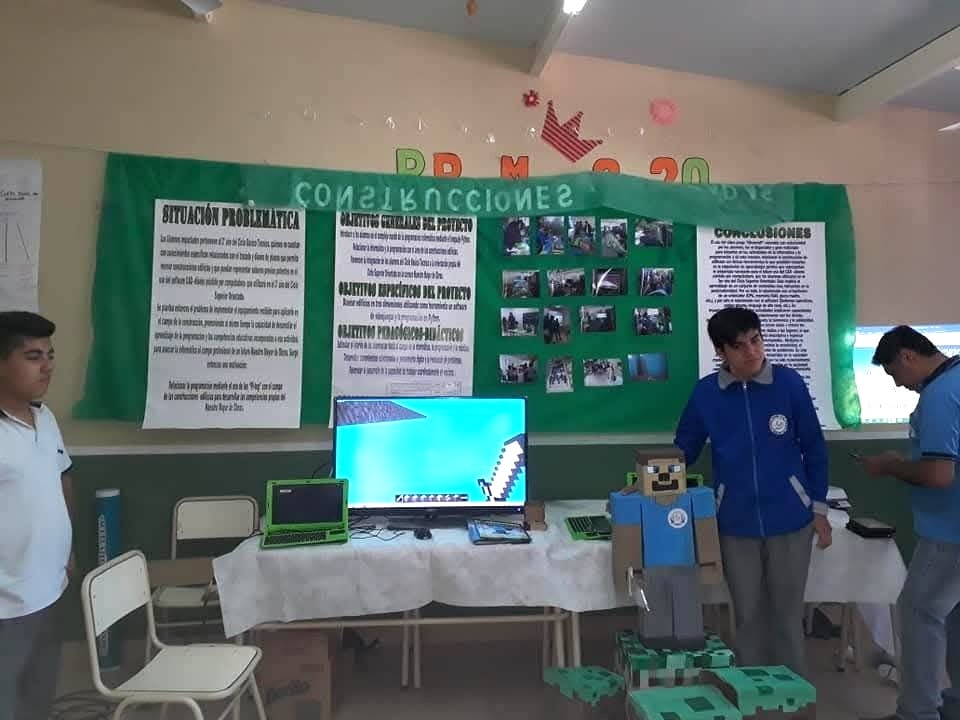
Teacher-Led Raspberry Pi Workshops Bring Coding and Robotics to Rural Argentina
Eliana Otrera, a teacher in Forres, Santiago del Estero, has helped introduce computing activities in rural Argentine schools and organize community Raspberry Jams. She began teaching coding and robotics in rural schools in 2017 through the Conectar Igualdad program, which introduced her to Raspberry Pi through educational Pi-Top computers. After promoting Raspberry Pi among colleagues, she and two collaborators held the province’s first community Raspberry Pi workshop in Forres on 6 March 2020, then continued sessions at schools and community venues in nearby areas. The article describes student work ranging from decorated electronic quiz games and basic robots to Python-and-Minecraft building projects. It also reports that a student greenhouse project has developed toward agricultural applications including irrigation control, drone deployment, and crop planning. These are examples recounted by the teacher; the article provides no independent evaluation, participant numbers, or quantified outcomes.
The article documents a sustained, locally organized computing-education effort and concrete student project examples, but offers no scale data or independent evidence of outcomes.
2026
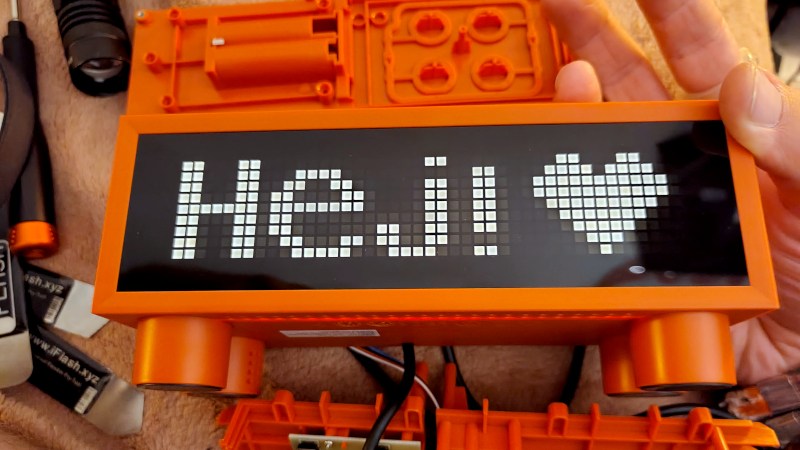
IKEA Kortlinje Clock Offers an Accessible LED-Matrix Hacking Target
The IKEA Kortlinje is a roughly $20 digital clock with a white LED-matrix display, thermometer and hygrometer. A hardware teardown found three VK1640 LED controllers, an unidentified microcontroller paired with a 32.768 kHz watch crystal, and an unmarked chip whose role is still uncertain; it may relate to I2C switching or the sensors. The report says the microcontroller can be desoldered and replaced, potentially giving a hobbyist control of the display drivers and I2C-connected functions. Early activity includes a RevSpace hackerspace post and an initial firmware effort on GitHub by VIPnytt. The device is therefore an emerging modification project, not a demonstrated, mature platform: the mystery chip has not been identified, and no completed custom firmware or broader capabilities are described.
The teardown identifies accessible display-control hardware and early community firmware work, but the chip functions remain uncertain and no completed hack or verified capabilities are reported.
2026

Free 3D-Printable Gothic Skull Lamp Uses Bambu’s MH001 LED Kit
Maker BattCave has shared files for a gothic skull-shaped USB LED lamp designed around the Bambu LED Lamp Kit MH001. The model uses a threaded base intended to simplify assembly, and colored gel films can be added to change the skull’s appearance. The listed print settings are 0.2 mm layers, three walls and 10% infill, with an estimated 17.6-hour print on one plate; PLA is recommended, and the showcased example uses Sunlu Matte White. The files are available on MakerWorld. The article presents the design and its suggested setup, but provides no independent measurements of brightness, print quality or assembly performance.
This is a usable, downloadable 3D-print design with specific print settings, but it is a single hobby lamp model and its illumination claims are not independently tested.
2026

Free 3D-Printable Skull Candle Nightlight Uses LED Strings or Tea Lights
Maker Mad_Power has shared a 3D-printable skull-shaped nightlight designed to resemble a melting candle. The project is intended as a Halloween decoration for a home or desk and is described as compatible with standard LED string lights as well as typical tea-light fixtures. The model can be printed using FDM in different colors, allowing users to vary its appearance. The article links to downloadable files on MakerWorld. It does not provide print settings, dimensions, electrical details, testing, or evidence about fit across specific light products, so those practical details cannot be confirmed from the supplied material.
The concrete item is a downloadable, FDM-printable decorative light with two stated lighting options; its novelty and practical scope are limited, and no technical specifications or compatibility testing are provided.
Carson Gross Argues That Programming Skills Will Remain Valuable Alongside AI
A brief post by Simon Willison quotes Carson Gross on the future of programming careers in the age of AI tools. Gross describes programming as combining problem-solving with computers and managing the complexity of solutions. He says he finds it difficult to imagine those capabilities becoming less valuable, and therefore expects programming to remain a viable career despite the advent of AI tools. The post offers a concise opinion rather than new empirical evidence: it provides no data, examples, or analysis of how AI is changing programming work.
This is a relevant career perspective on AI and programming, but it is a short quoted opinion without supporting data or evidence of a concrete industry change.

DIY Chromalux Lamp Combines a 3D-Printed Shade with Addressable LEDs
The featured Chromalux project, shared by luxellights on MakerWorld, is a DIY RGB lamp combining a 3D-printed base with interchangeable shade designs. Its listed electronics are an ESP8266 controller and six WS2812B LED-strip sections, each with 12 LEDs, for about 72 LEDs in total. The design calls for roughly 1.5 meters of strip with a width of 10 mm or less, and the post says a 5V, 2A USB charger is sufficient. It uses WLED firmware, installed through install.wled.me, and is configured as six segments. The project files are offered under a CC BY-NC license. The material describes a maker build and its components, not independent testing or a newly released commercial product; it provides no measured brightness, operating results, or detailed build instructions in the supplied text.
A concrete, replicable maker lamp specifies its controller, LEDs, power, and WLED setup; the material gives no independent performance tests and is not a commercial launch.

Three 3D-Printable Tombstone Tea-Light Holders Use a Fuzzy-Skin Finish
Maxx_Design has shared a set of three tombstone-shaped tea-light holders intended for 3D printing, with an alternative design that omits crosses. The holders are described as fitting round tea lights up to 40 mm in diameter and use a two-piece construction. The print guidance specifies orienting the tombstones at a 45-degree angle; the base plates use 150% flow and a Hilbert-curve pattern to create the fuzzy top texture. The lower portions of the stones should be printed without fuzzy skin so the parts fit together properly. The files include preconfigured profiles with custom fuzzy-skin settings and manual supports. The material also notes a commercial license via Patreon, but does not provide print-test results or further details on licensing terms.
The concrete contribution is a downloadable 3D-printable design set with fit and print-setting details; its value is mainly a niche seasonal maker project, with no performance testing reported.

John Park’s Workshop Announces Its Regular Live Maker Show for October 8
Adafruit’s post announces that John Park’s Workshop will stream live on October 8 at its usual time of 4 p.m. ET / 1 p.m. PT, with text chat in the Adafruit Discord. It says the video will be available on YouTube Live, Twitch, Periscope (Twitter), and Facebook. The weekly program features John Park building, demonstrating, hacking, and modifying projects, and may cover topics such as CircuitPython, tools, retro gear, and projects using digital fabrication, hand and power tools, and microcontrollers. The post is a schedule reminder, not a new product or technical development; it provides no specific episode project details or performance evidence.
The post gives a date, time, chat location, and streaming platforms for a recurring maker show, but reports no new project or technical result.

3D-Printed Mobile Case Combines Raspberry Pi Zero W, LiPo Battery and USB-C Charging
A maker-designed 3D-printed enclosure for Raspberry Pi Zero W projects is presented as a compact option for portable builds. The case is described as accommodating the board, a 2000mAh LiPo battery and a 5V USB boost converter. Listed features include a USB-C charging input, access to the microSD card and an MN1 physical power switch intended for safe shutdown; the design is also described as having a close fit and limited cable-management needs. STL files are included, making the enclosure design available for printing. The article does not provide independent testing, dimensions, battery runtime, charging details or evidence for its suggested mobile and low-power uses, so those capabilities should be treated as design claims rather than verified performance.
The concrete contribution is a printable enclosure design with specified power components and access features. The article supplies no measurements or performance testing to validate its portability or operation.

BIGWORDS.PAGE Turns a URL into a Lightweight Digital Signage Display
BIGWORDS.PAGE, a web project by SpeakingOfBrad, lets users create text displays by encoding content and styling options in a URL, then sharing that link with browsers on other devices. The article describes support for text, font and text colors, images, countdown timers, and animated presentations spanning multiple pages. A visual editor can generate a finished link, while the URL format can also be assembled manually. The project is released under the MIT license, and its documentation explains how to self-host it, including for displays on a local network that should not each connect to the public internet. The material presents this as a simple browser-based way to distribute display content; it does not provide independent testing, deployment scale, or performance data.
This is a usable, MIT-licensed browser signage project with several content modes and self-hosting instructions, but the article offers no independent testing or evidence of broader deployment.

Two Lightweight 3D-Printed Headbands Offer Quick Halloween Costume Props
The article highlights two 3D-printable Halloween headband designs shared by themapster: a witch-hat headband and a knife-through-the-head prop. The supplied material lists estimated print times of 50 minutes and 27 minutes, respectively, and describes the designs as lightweight and requiring little filament. It says multiple print profiles are available for either filament color changes or single-color prints, and that the designer plans to add more designs. Files are linked on MakerWorld. The article provides no independent testing or details on printer settings, material requirements, fit, or safety; the 5.0/5 rating mentioned for the witch-hat design is not accompanied by rating volume or verification.
This is a small, concrete 3D-printable prop release with stated print times and linked files; its limited scope and lack of independent validation keep its broader value modest.

Articulated Rexagon Combines T-Rex and Dragon Features in a Support-Free 3D Print
PinkyWings’ Articulated Rexagon is a poseable flexi model combining T-Rex and dragon characteristics. The model is offered in two-color and three-color versions and is designed to print without support structures. The supplied material lists print times of 1.6 to 5.9 hours depending on the variant, with optimized profiles for Bambu A1, X1, H2D, and P1S printers. A dedicated two-color H2D version is listed at 1.6 hours. Suggested settings are a 0.2 mm layer height, two walls, and 5% infill. The article describes this as a return of a non-Halloween flexi to the lineup; it does not provide independent print testing. Commercial use requires Patreon membership.
This is a specific, usable 3D-print model with printer profiles and settings, but the article offers no independent validation and the release is a niche design.

DSPi Brings Multichannel Audio DSP to Raspberry Pi Pico and Pico 2
Weeb Labs has published DSPi, GPL v3 firmware that configures the Raspberry Pi Pico (RP2040) and Pico 2 (RP2350) as USB sound cards with onboard digital signal processing. Listed functions include room correction, active crossovers, parametric equalization, time alignment, loudness compensation and headphone crossfeed. Both boards run at a fixed 307.2 MHz clock, selected to keep PIO dividers integer at 44.1, 48 and 96 kHz; the RP2040 requires a small voltage increase. The article says the RP2350’s hardware floating-point unit gives it capacity for 11 channels and 9 outputs, compared with 7 channels and 5 outputs on RP2040. Output slots can switch between S/PDIF and I2S at runtime, with both formats usable on one device. Pin assignments can be changed without reflashing and saved in one of ten presets. A Core 1 delta-sigma modulator provides a PDM subwoofer output through a simple RC low-pass filter. The firmware builds with the standard Pico C/C++ toolchain; the article provides no independent performance measurements.
This is a concrete open-source firmware release with configurable multichannel DSP and interface options; the article gives feature and channel counts but no independent performance testing.

Three Printable Halloween Tombstone Designs Offer Quick Maker-Themed Decorations
A featured MakerWorld upload by tim_hrt offers three small 3D-printable tombstone designs with humorous inscriptions, including “RIP My Filament Supply,” “Game Over” and “R.I.P.” The supplied article lists estimated print times of 49 minutes, one hour and 1.1 hours, respectively, and says each design fits on one plate and requires minimal supports. It also reports a 5.0-star rating for all three designs, though no rating counts or independent print tests are provided. The files are presented as tabletop or desk decorations for Halloween, with the filament-themed wording aimed at 3D-printing enthusiasts. This is a small seasonal design feature rather than a new printer, material or printing technique.
The post identifies three downloadable designs and gives print-time estimates, but this is a modest seasonal project feature with no independent validation or broader technical advance.

Adafruit Showcases Pepper’s Ghost Monster Eyes and a Floating Ghost 3D Print
Adafruit’s weekly 3D Hangouts post highlights a Pepper’s Ghost monster-eye project and revisits its Marquee display, alongside a time-lapse featuring a floating ghost dog model by O3D. The post links to guides for the Pepper’s Ghost effect and Adafruit Monster Eyes, and lists hardware including the Qualia ESP32-S3, a 2.1-inch round TFT, and a 2.9-inch MagTag e-ink display. It also points readers to community-made 3D printing projects and describes how printed enclosures, brackets, and sculptures can be combined with electronics. The material is a roundup of existing guides, components, and community work; it does not announce a new product or provide performance tests or detailed build instructions in the article itself.
This is a relevant hardware-and-making roundup, but its main value is links to existing guides and a showcased 3D model; no new product or independently verified technical result is reported.
Adafruit Guide Builds a Pepper’s Ghost Monster Eye with Qualia ESP32-S3
Adafruit’s new project guide demonstrates a desktop Pepper’s Ghost effect built around its Qualia ESP32-S3 and a 2.1-inch round TFT display. The animated “Monster Eye” illusion is assembled inside the Adafruit DIY Snow Globe Kit, with a 3D-printed enclosure holding the electronics and a clear plastic reflector that builders can cut themselves. The material identifies the main components and points readers to the full guide, but does not provide details about software requirements, build time, cost, or testing. This is a reproducible maker-project example rather than a new hardware release or evidence of a broader change in product capability.
The guide offers a concrete, reusable microcontroller-and-display build for hardware makers; its scope is a single DIY project, with no reported performance testing or broader technical advance.
Adafruit Highlights a 3D-Printed Floating Ghost Dog Tealight Holder
Adafruit’s weekly #3DThursday feature showcases O3D’s “Floating Ghost Dog,” a Halloween-themed tealight holder listed on MakerWorld. The post reports a print made on a Bambu X1C using PolyMaker PLA: 110 × 94 × 74 mm, 36 g of filament, and a print time of 2 hours 18 minutes. Its stated settings are a 0.2 mm layer height, 0.4 mm nozzle, 10% infill, 1 mm retraction, and temperatures of 200°C for the nozzle and 60°C for the bed; it also lists a print speed of 230 mm/s. The article describes the weekly community showcase but does not provide independent testing, print-quality evidence, or further details about the model’s design or operation.
This is a relevant, concrete 3D-print example with dimensions, material, print time, and slicer settings; its value is limited to a community showcase rather than a new printer or validated performance result.

3D-Printed Desk Cable Organizer Uses Rotating Snap-Latch Tubes
Maker mgm86 has shared a desk-mounted cable organizer designed to keep frequently used leads accessible on the desktop. The holder is offered in configurations with three, five or seven tubes; each tube rotates 180 degrees to open or close and uses a snap latch. The body pushes onto a base, and the tubes can be removed and replaced. It attaches with double-sided adhesive tape, with the designer recommending masking tape underneath for sensitive surfaces. The post also describes a May 2026 V2 with an improved spring mechanism said to work with all filament types, and notes that the multicolor design can be printed without an AMS system. The material describes a community-shared 3D-printable design, not independently tested durability or performance.
This is a concrete, printable hardware design with useful configuration and mounting details, but it is a narrow community project and its spring and compatibility claims are not independently verified.