

Garlic-Peel Triboelectric Sensor Generates Power When a Door Opens
Reading lead
Researchers Manas Tiwari and Deepak Bharti developed a door-and-window sensor based on a triboelectric nanogenerator, using ground garlic peel as the positive material and polyethylene as the negative layer. The article reports that opening a door produced about 210 volts AC at a short-circuit current of 45 microamps; a two-sided garlic-peel layer raised the reported output to 400 volts AC and 65 microamps. In the described setup, a separate microcontroller detected the generated current but ran from a power bank, so the demonstration did not eliminate the need for an external power source. The authors suggest the harvested energy might support a brief low-power wireless transmission, but that use is presented as a possibility, not a demonstrated result. The sensor reportedly remained functional after six months in storage and 200 stress cycles. The underlying research paper is paywalled, and the article provides no independent validation or detailed performance data.
Article body
Image unavailable. Open source image ↗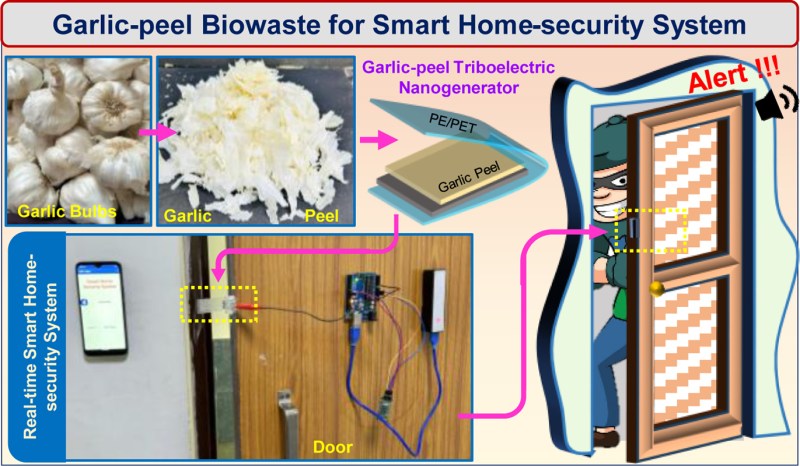
Most home security sensors require a chemical battery or external power source to operate, which can be a point of weakness. If the battery in a window or door sensor dies overnight and nobody is there to swap it, it might miss that one intruder or mess up your carefully curated home automation system. In that sense self-powered sensors are rather interesting, such as this one by [Manas Tiwari] and [Deepak Bharti] that is based around the triboelectric effect.
The research article is sadly paywalled, but the IEEE Spectrum article covers all the salient details. The sensor uses ground up garlic peel for the positive side of this triboelectric nanogenerator (TENG) as they call it, with a sheet of polyethylene (PE) forming the negative side. Once installed on a door frame, opening said door generates about 210 VAC with a 45 µA short circuit current. A dual-side layer of garlic peel bumps this up to 400 VAC and 65 µA.
As installed, the researchers used this generated current to detect changes using a separate MCU running off a powerbank, which obviously does not really solve the ‘running out of charge’ issue. The generated power could conceivably be used to send a brief wireless packet to a receiver elsewhere in the room, somewhat like the Bluetooth link in the example, but more low-power.
The researchers also reported that this sensor was still functional after half a year in storage, and survived 200 stress cycles, which seems like a good start for what appears to be a very cheap sensor to construct.
Source: Maya Posch ·Hackaday · 2026-10-09T02:00:05.000Z · Read the original article
Why read this
The material describes a specific garlic-peel energy-harvesting sensor and reports output and durability figures, but its demonstrated MCU still needs a power bank and the research paper is paywalled.
AI score 40 · View scoring rationale
Two-model scores assess source reading value, not factual accuracy. Check this editorial article against the original.
- gpt-6-luna-2026-09-22 · 43
The material describes a specific garlic-peel energy-harvesting sensor and reports output and durability figures, but its demonstrated MCU still needs a power bank and the research paper is paywalled.
- deepseek-flash · 38
Relevant self-powered sensor hardware with concrete voltage, current, storage and stress-cycle figures, but the demonstrated setup still relies on a powerbank-fed MCU, so practical autonomy is unproven and evidence is limited to a paywalled paper and secondary coverage.
Analyzed: 2026.10.10 02:41 UTC
Comments & answers 0