

Maker Builds a Retro Bluetooth Handset to Reduce Smartphone Distractions
导读
Kevin Noki has built a retro-styled Bluetooth handset as an alternative way to handle calls without picking up a smartphone. The device is not a standalone cellular phone: it pairs with a separate, professionally approved phone, since the build has no cellular modem and custom hardware access to VoLTE is difficult in many places. Noki initially used an ESP32, but switched to a dedicated Bluetooth Hands Free Profile module after finding the audio quality too poor. The project video shows a case-design process that uses XPS foam and a hand-operated hot-wire cutter for quick form iterations, followed by a single 3D-printed final case; a simple jig is used to bend the dark acrylic covering the display. The design is offered on Noki’s website, while the article says the on-screen details may be enough for others to reproduce it without purchasing the design. The handset can reduce the need to interact directly with a phone, but does not replace one.
正文
配图暂未加载。 查看来源原图 ↗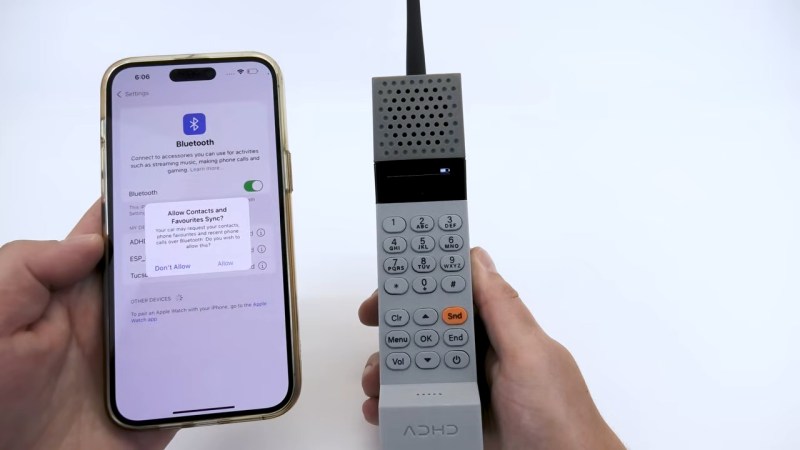
Like more than a few of us , [Kevin Noki] is sick of being pulled out of flow state by that annoyingly addictive black rectangle we all carry around. His solution was to build a phone to escape his phone, in a YouTube video we embedded down below. We’d say that phone is straight out of the 1980s, except it’s not quite a phone. It would perhaps be more accurate to say he’s building a Bluetooth handset– actual telephony remains the province of a professional device with regulatory approval, because getting custom hardware on VoLTE is a nonstarter in many places.
He starts out using an ESP32, because he already had one and why not? It’s got bluetooth, after all. Alas, audio quality he was getting through it was a little too crunchy, so he pivoted to use a dedicated Hands Free Profile (HFP) bluetooth module that is purpose built for exactly this kind of application. He’s selling the design on his website, but given how much detail he shows on screen, recreating your own version would be easy enough to save the quid. You’d be missing out on the STL for the fantastic 80s brick he’s made, which may be the most interesting part of the build to us.
We’d likely have jumped right to CAD and printed out a few iterations of the case until we were happy, but [Kevin] takes a more traditional industrial-design approach, mocking up the phone with XPS foam and a manually-operated hot wire cutter. It’s not a step we see makers take very often, but it pays off here– at least for subtracting material, it’s a very quick way to iterate, and he only needs to do one 3D print for the final version. We also like very high-tech acrylic bending jig, which he uses to put some black LED acrylic over the display.
It’s a lot of work to make you less-likely to grab a phone you still need anyway– remember, there’s no cellular modem in this– but, hey, it beats torturing yourself, or worse, a tamagotchi.
Source: Tyler August ·Hackaday · 2026-10-08T20:00:31.000Z · Read the original article
推荐理由
The project demonstrates a concrete Bluetooth handset build and practical fabrication choices, but it depends on a separate phone and does not provide cellular service or independently verified performance.
AI评分 42 · 查看评分依据
双模型按来源原文评估阅读价值,不判断事实真伪;本站整理正文仍应与原文核对。
- gpt-6-luna-2026-09-22 · 36
The project demonstrates a concrete Bluetooth handset build and practical fabrication choices, but it depends on a separate phone and does not provide cellular service or independently verified performance.
- deepseek-flash · 49
Covers a concrete DIY hardware build with specifics on the HFP module choice, ESP32 audio limits, and foam prototyping, but it is a personal maker project with no product launch, no independent testing, and no cellular capability.
分析时间:2026.10.10 02:43 UTC
评论与解答 0